The India vs Japan cricket match in 2026 was never going to be just another T20 fixture.
It was the first men’s international cricket meeting between India and Japan, played at the Sano International Cricket Ground in Tochigi on September 22, 2026. The match was also part of celebrations marking 75 years of India-Japan diplomatic relations and served as an important preparation game before the men’s cricket competition at the 2026 Asian Games.
What nobody expected was how close the contest would become.
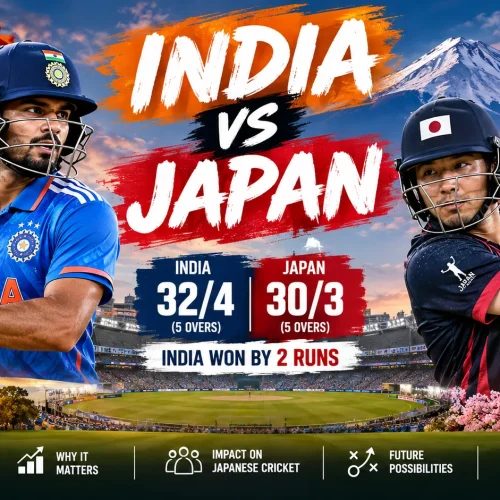
India, the reigning ICC Men’s T20 World Cup champions, were restricted to just 32/4 in five overs after rain reduced the match to a five-over-a-side contest. Japan then pushed India all the way, finishing on 30/3 and losing by only two runs.
On paper, India won.
On the field, however, Japan showed that its cricket story is developing faster than many outside the country might realise.
And that is what makes India vs Japan such an interesting cricket story.
India vs Japan Match Overview
| Detail | Information |
|---|---|
| Match | Japan vs India |
| Competition | Suzuki Cup – India-Japan 75th Anniversary Match |
| Date | September 22, 2026 |
| Venue | Sano International Cricket Ground, Tochigi, Japan |
| Format | T20 International |
| India | 32/4 in 5 overs |
| Japan | 30/3 in 5 overs |
| Result | India won by 2 runs |
| India Captain | Shreyas Iyer |
| Japan Captain | Kendel Kadowaki-Fleming |
The Japan Cricket Association officially recorded the result as Japan 30/3 versus India 32/4, with India winning by two runs.


A Match That Made History Before the First Ball
The first important point about India vs Japan is simple: these two men’s teams had never met in international cricket before this fixture.
The ICC confirmed that the September 22 contest would be the first-ever men’s international cricket match between India and Japan. India arrived as reigning T20 World Cup champions, while Japan entered the contest looking to gain experience against one of cricket’s strongest international sides.
The match was organised as the Suzuki Cup – 75th Anniversary Match Celebrating Japan-India Diplomatic Relations.
That gave the game significance beyond cricket.
For India, it was an opportunity to prepare for the Asian Games. For Japan, it was a chance to put its developing cricket structure under the spotlight.
The Japan Cricket Association described the contest as a landmark event for Japanese cricket, while the BCCI said the match was part of the broader “Sport 75” initiative connected with the 75th anniversary of diplomatic relations.
So although the scorecard says India vs Japan, the bigger story is about how cricket is moving into a new market.
How India vs Japan Became a Two-Run Thriller
The original match was supposed to provide a conventional T20 contest.
Weather had other plans.
Rain affected preparations around the match, and the game was eventually reduced to only five overs per side. That changed everything.
In a normal 20-over game, a stronger squad generally has more time to recover from a poor start. A five-over match leaves almost no room.
One wicket can change the entire contest.
One boundary can change the required run rate.
One wide can become hugely important.
India batted first and managed 32/4.
That was an unusually low total for a side containing several international-level players, but the shortened format and conditions created a completely different game. Japan’s bowlers made the most of the opportunity.
Japan then began the chase.
India’s bowlers were expected to control the innings, but Japan refused to disappear from the contest.
The hosts eventually reached 30/3, falling only two runs short.
That margin is tiny.
For a five-over game, it meant the match came down to a handful of deliveries.
Japan’s Fast Start Changed the Story
One of the biggest talking points from the India vs Japan match was Japan’s bowling performance.
According to the match report, Charlie Hara-Hinze dismissed Abhishek Sharma in the first over before removing Ishan Kishan in the following over. Those early wickets prevented India from building the kind of momentum normally expected from their top order.
That was important for Japan.
Instead of treating the occasion as an exhibition, Japan attacked.
This is exactly the mentality captain Kendel Kadowaki-Fleming had spoken about before the game.
He said Japan did not want simply to celebrate playing India. The team wanted to show what it could do as a men’s side.
That attitude was visible in the five-over contest.
Shreyas Iyer Provides India With Stability
India needed somebody to stop the innings from collapsing completely.
That responsibility fell to captain Shreyas Iyer.
Iyer scored 16 from 12 deliveries, helping India reach 32/4. In such a short match, those runs became extremely valuable.
There was no opportunity to construct a conventional innings.
There was no time to settle.
Every ball mattered.
That is why the Indian captain’s contribution was important even though the final score was small.
Japan’s Chase and the Final Over Drama
Japan began its chase carefully.
India used spin early, with Axar Patel dismissing Lachlan Yamamoto-Lake. Washington Sundar also picked up a wicket, while Japan captain Kendel Kadowaki-Fleming contributed 12 runs before being dismissed.
By the final over, Japan had put itself in a position where victory was genuinely possible.
India eventually defended the target.
But the closing stages produced controversy around a wide call and the sequence of deliveries that followed. International reports noted the debate surrounding the umpiring decision, although the official scorecard records India as the two-run winner.
For Japan, the disappointment was understandable.
They had taken the reigning T20 World Cup champions to the final moments.
For India, the match provided a reminder that shortened cricket can produce completely different dynamics.
India vs Japan Was More Than a Result
The scorecard tells us India won.
The larger cricket story tells us something else.
Japan can compete.
Not yet consistently against the world’s strongest teams. Not yet with the depth India possesses. But the gap is not simply about talent anymore.
It is also about experience, infrastructure, professional opportunities, coaching, competition and the number of players entering the sport.
That distinction matters.
Japan’s captain has openly spoken about the possibility of cricket becoming much bigger in Japan over the next 20 or 30 years. ICC reported that Kadowaki-Fleming sees the India fixture as potentially the beginning of a longer relationship with Full Member nations.
That is perhaps the most important part of the entire India vs Japan story.
Why India vs Japan Matters for Japanese Cricket
Japan is traditionally associated with baseball, football and other established sports.
Cricket does not have the same cultural footprint.
But that does not mean the sport has no foundation.
The Japan Cricket Association has been developing national teams, domestic competitions, academies and youth pathways.
Japan is also an ICC Associate Member, and its men’s team has been increasingly involved in international competitions. ICC reported that Japan finished second in the 2026 Men’s T20 World Cup East Asia-Pacific Qualifier, level on points with Papua New Guinea but behind them on net run rate.
That is a useful indicator of progress.
Japan’s cricket development is not happening overnight.
It is being built gradually.
Charlie Hara-Hinze Represents the Next Generation
One name that deserves attention is Charlie Hara-Hinze.
The young Japan all-rounder was part of Japan’s Under-19 World Cup campaign and was selected for the senior squad. ICC noted that he had already faced Indian young players including Ayush Mhatre and Vaibhav Sooryavanshi at the 2024 Under-19 Asia Cup.
That is important because international cricket development starts long before senior-level success.
If Japanese players can regularly face strong cricketing nations at youth level, they can learn:
- How international bowlers operate
- How quickly top batters score
- How fielding standards differ
- How pressure changes decision-making
- How professional teams prepare
- How to handle big crowds and expectations
These lessons cannot be fully recreated in training sessions.
Players need actual matches.
What India Can Gain From Playing Japan
It would be easy to look at this match and say that only Japan benefited.
That would be too simple.
India also had reasons to play.
The match came immediately before the Asian Games, where India entered as defending men’s champions. ICC confirmed that the men’s cricket competition runs from September 24 to October 3, with India entering at the quarter-final stage.
For India, the Japan game offered a different type of preparation.
1. Adaptation to unfamiliar conditions
Indian players rarely need to adjust to Japanese cricket grounds.
Playing in Sano provided a different environment.
That matters because international tournaments are not always played in familiar conditions.
2. Short-format pressure
The five-over match was unusual, but it created an extreme pressure situation.
India had to make decisions quickly.
3. Opportunity for players
The Indian squad included established international players as well as younger names.
The Asian Games squad featured players including Shreyas Iyer, Abhishek Sharma, Sanju Samson, Ishan Kishan, Tilak Varma, Shivam Dube, Axar Patel, Washington Sundar, Ravi Bishnoi, Jasprit Bumrah, Arshdeep Singh and Vaibhav Sooryavanshi.
That combination of experience and youth is significant for India’s future T20 planning.
The Asian Games Connection
The timing of India vs Japan was not accidental.
The men’s cricket tournament at the Aichi-Nagoya 2026 Asian Games began only days later.
India entered the tournament directly at the quarter-final stage, while Japan had to come through the group phase.
That creates an interesting situation.
Japan gets more competitive matches.
India gets additional preparation before the knockout phase.
Both teams have different objectives.
For Japan, every Asian Games game provides experience.
For India, every knockout game carries medal implications.
And if the tournament structure produces another India-Japan meeting, the teams would arrive with even more knowledge of each other.
India vs Japan and the Future of Cricket in Japan
This is where the story becomes much bigger.
A country does not build a cricket culture simply by organising one major match.
It needs a complete pathway.
The pathway should look something like this
Schools → Junior Cricket → Academies → Domestic Cricket → National Academy → Senior National Team → International Cricket
Japan already has pieces of this structure.
The next challenge is expanding participation.
That means getting more children involved.
More clubs.
More coaches.
More grounds.
More domestic competitions.
More opportunities for young players to see international cricket.
And, perhaps most importantly, more regular matches against stronger international teams.
Why India Could Play a Major Role
India has enormous cricketing influence.
That influence can extend beyond the Indian team itself.
Indian coaches, former players, academies, franchise organisations and cricket businesses could potentially contribute to the development of Japanese cricket through coaching exchanges, camps and grassroots programmes.
Japan’s captain has already described the possibility of young Japanese children watching Indian players and becoming interested in cricket.
That is a powerful idea.
A child does not always start playing a sport because of a school programme.
Sometimes they watch a player.
They see a big six.
They see a fast bowler.
They see a dramatic catch.
Then they ask:
“Can I play cricket too?”
That moment can be the beginning of a career.
The Role of the Asian Games
The Asian Games could become another major development platform.
Japan’s men’s team was scheduled to play Afghanistan in the opening match of the men’s cricket competition on September 24, immediately after the India fixture. The Japan Cricket Association lists that match at Korogi Park.
Facing teams such as Afghanistan, Nepal, Hong Kong and Malaysia gives Japan a broader competitive environment.
That is exactly what developing cricket nations need.
Not one big match.
Regular competitive matches.
What Japan Needs to Do Next
The India vs Japan match created attention.
The next challenge is converting attention into participation.
1. Build stronger youth cricket
Youth development has to remain the foundation.
Japan needs more school-level cricket, junior tournaments and structured coaching.
2. Increase domestic competition
Players improve when they face strong opposition regularly.
A deeper domestic competition can create more selection options for the national team.
3. Develop specialist coaches
Modern T20 cricket requires specialists.
Batting coaches.
Bowling coaches.
Fielding coaches.
Strength and conditioning staff.
Analysts.
Japan does not need to copy India’s entire system, but it can learn from established cricket nations.
4. Give young players international exposure
The experience of players such as Charlie Hara-Hinze shows why youth international cricket matters.
Young Japanese players need opportunities to face teams from different cricket cultures.
5. Create cricket heroes
This could be one of the biggest long-term challenges.
Japanese cricket needs players that children can recognise.
Players whose shirts they want to wear.
Players they want to imitate.
Players who make cricket feel like a Japanese sport rather than simply an imported sport.
What India Needs to Learn From the Match
India should not dismiss a two-run victory simply because it came against an Associate nation.
Short-format cricket has always had surprises.
But there is another lesson.
India’s future T20 teams will increasingly need players who can adapt instantly.
The modern T20 game rewards:
- Fast decision-making
- Flexible batting orders
- Multi-skilled players
- Accurate death bowling
- Strong fielding
- Ability to perform in unfamiliar conditions
- Tactical awareness
The Japan match was only five overs per side, but those principles were still visible.
The Future of India vs Japan Cricket
The biggest question is not whether India can beat Japan.
The more interesting question is:
How often will India and Japan play each other in the future?
That is where this historic match could become important.
One game can be a special event.
A series of games can create a cricket relationship.
Regular youth fixtures can build a pathway.
Coaching exchanges can strengthen development.
Domestic leagues can create opportunities.
And eventually, Japan could become a much more competitive cricket nation.
ICC reported that Japan’s players themselves believe there is potential for the country to develop significantly over the next two or three decades.
Twenty or thirty years sounds like a long time in sport.
But cricket is a patient game.
Its strongest traditions were not created in a few seasons.
They were built over generations.
India vs Japan Could Become a New Cricket Rivalry
Calling India vs Japan a rivalry today would be premature.
There is not enough history.
There have not been decades of close matches.
There is no established competitive record between the men’s teams.
But every rivalry has to start somewhere.
The September 22, 2026 match created the first chapter.
And it was a memorable one.
India won by two runs.
Japan came within touching distance of a major upset.
The match was played in front of Japanese supporters and created an opportunity to introduce a wider Japanese audience to international cricket.
That is a strong starting point.
Why the Result Matters Less Than the Opportunity
The final score will remain in the record books:
India 32/4
Japan 30/3
India won by 2 runs.
But years from now, the more important question may be what happened after that match.
Did more children start playing cricket?
Did more Japanese schools introduce the sport?
Did domestic competitions grow?
Did Japanese players get more international opportunities?
Did India return to Japan?
Did young Japanese players eventually become professional cricketers?
Those questions will determine the true impact of India vs Japan.
India vs Japan and the Global Expansion of Cricket
Cricket is moving beyond its traditional markets.
The India vs Japan match fits naturally into that wider story.
The ICC has highlighted the importance of cricket’s expansion into new regions, while the Japan Cricket Association has been actively developing the sport domestically. Japan also hosted the Asian Games cricket competition in 2026, giving the country another opportunity to put the sport in front of a wider audience.
The bigger opportunity is not simply finding more spectators.
It is creating players.
Spectators watch.
Players build the sport.
If even a small percentage of young people who watched India vs Japan decide to pick up a bat or join a cricket club, the match will have achieved something beyond its result.
That is exactly the kind of long-term impact Japan’s captain highlighted before the game.
Final Thoughts on India vs Japan
The India vs Japan cricket match in 2026 will be remembered for several reasons.
It was the first men’s international meeting between the two countries.
It was part of the 75th-anniversary celebrations of India-Japan diplomatic relations.
It was played in Japan.
It featured the reigning T20 World Cup champions.
It was reduced to five overs because of weather.
And, most importantly, Japan came within two runs of holding India to a remarkable result.
But the real value of the match goes beyond 10 overs of cricket.
For India, it was preparation for another major tournament and an opportunity to adapt to unfamiliar conditions.
For Japan, it was a rare chance to test its players against one of the strongest teams in world cricket.
For Japanese cricket, it was a shop window.
For young players, it was an invitation.
And for global cricket, it was another reminder that the sport’s future does not have to remain limited to its traditional markets.
The road ahead for Japanese cricket will not be easy. Building a strong cricket culture takes years of investment, coaching, competition and grassroots participation.
But every cricketing country has to start somewhere.
Japan’s next chapter may have started with a two-run defeat to India.
And sometimes, in sport, the narrowest defeats become the games people remember.
Japan Cricket Association official website
India vs Japan 2026 Key Takeaways
- First men’s international meeting: India and Japan played each other for the first time in men’s international cricket.
- Historic venue: The match was played at Sano International Cricket Ground in Tochigi, Japan.
- Five-over thriller: Rain reduced the contest to five overs per side.
- India won: India scored 32/4 and Japan finished 30/3.
- Winning margin: India won by just two runs.
- Japan’s opportunity: The fixture provided Japanese players with experience against the reigning T20 World Cup champions.
- Asian Games preparation: The game came immediately before the men’s cricket competition at the Aichi-Nagoya 2026 Asian Games.
- Long-term impact: Japan’s cricket leadership sees international exposure as part of a much longer-term development plan for the sport in the country.