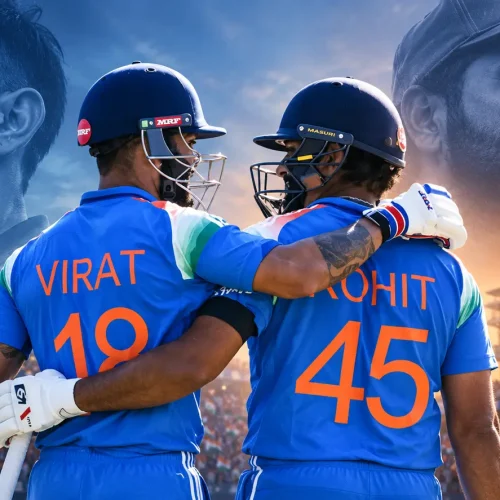
Indian cricket has produced countless great batsmen, but very few have carried the weight of an entire generation on their shoulders. Sachin Tendulkar did it for more than two decades. Virat Kohli took over that responsibility in a completely different era and built a legacy of his own.
That is why Sachin Tendulkar vs Virat Kohli is not simply a comparison of runs, centuries or averages.
It is a comparison between two eras of cricket.
Sachin played through a period when batting was often a contest of patience, technique and survival against some of the most feared bowlers in cricket history. Kohli developed his game in an era dominated by data, advanced fitness, better bats, DRS, sophisticated coaching, shorter formats and aggressive batting strategies.
Both are extraordinary.
But the conditions under which they achieved their numbers were not identical.
Sachin’s generation demanded a different kind of toughness. Kohli’s generation demands a different kind of adaptability.
So when the question is asked about Sachin Tendulkar vs Virat Kohli, the fairest approach is not to simply put their career statistics next to each other and declare a winner. We need to understand the cricket they actually played.
Sachin Tendulkar vs Virat Kohli Is Really a Battle Between Two Eras
The first thing to understand is that Sachin and Kohli belong to different cricketing worlds.
Sachin Tendulkar made his international debut in 1989 as a 16-year-old and finished his international career in 2013. The ICC records him with 15,921 Test runs, 18,426 ODI runs and 100 international centuries. He also became the first player to play 200 Tests and the first to score a men’s ODI double century.
Virat Kohli’s international career began in the late 2000s. He went on to become one of the defining batsmen of the modern generation and retired from Test cricket in 2025 with 9,230 runs from 123 Tests and 30 Test centuries.
Looking only at these numbers can make the comparison appear straightforward.
It is not.
Sachin’s career lasted longer at the highest level, while Kohli’s career belongs to a period in which cricket has become considerably more technology-driven and format-heavy.
The game itself changed.
And that matters.
The Sachin Tendulkar Era Was a Different Cricketing Battlefield
To understand Sachin’s greatness, you have to look at the bowlers he regularly faced.
The 1990s and early 2000s featured an extraordinary collection of fast bowlers and spinners.
Wasim Akram.
Waqar Younis.
Glenn McGrath.
Curtly Ambrose.
Courtney Walsh.
Allan Donald.
Shane Warne.
Muttiah Muralitharan.
Anil Kumble.
Chaminda Vaas.
These were not ordinary international bowlers.
They were match winners.
The ICC’s historical rankings from the 1996 World Cup period provide a good snapshot of the bowling strength of that era. Curtly Ambrose was ranked No. 1, followed by Shane Warne, Wasim Akram, Glenn McGrath and Anil Kumble, with Chaminda Vaas and Courtney Walsh also among the leading bowlers.
That list tells its own story.
A batsman could walk out to face one of the greatest fast bowlers in history and then potentially encounter another world-class bowler after a few overs.
Sachin did this repeatedly.
And he did it without many of the technological protections modern batsmen have today.
There Was No DRS to Correct a Bad Decision
This is one of the biggest differences between the two eras.
Today, if a batsman is given out LBW and believes the decision is wrong, his team can request a review.
Ball tracking can examine the projected path of the delivery.
UltraEdge or other approved sound-based technology can help determine whether there was an edge.
Replays can provide additional evidence.
The ICC describes DRS as a technology-based process that allows umpires and players to use technology when reviewing decisions.
But Sachin spent the majority of his career without this safety net.
The first international trials of a player referral system took place in the India vs Sri Lanka series in 2008, while the DRS officially went into operation in 2009.
That means a substantial part of Sachin’s career was played under a system where an incorrect on-field decision could simply end an innings.
No review.
No ball tracking.
No modern edge detection.
No opportunity for the batsman to challenge the call.
That does not mean every dismissal Sachin suffered was wrong. It would be unfair to make that claim without evidence.
But it does mean that the possibility of an incorrect decision had to be accepted as part of the game.
Modern batsmen have a mechanism to challenge some of those decisions.
Sachin often did not.
That is an important part of the Sachin Tendulkar vs Virat Kohli debate.
Technology Has Changed the Way Batting Works
Modern cricket is heavily influenced by technology.
A batsman today can study thousands of deliveries from an opponent before facing him.
Coaches can break down release points.
Analysts can identify scoring areas.
Teams can examine dismissal patterns.
Batsmen can prepare for specific bowlers with detailed video analysis.
During a match, DRS can potentially correct an incorrect decision.
The ICC has also introduced technologies such as ball tracking, edge detection, infrared cameras and other systems designed to improve decision-making.
This does not make modern batsmen less talented.
Far from it.
It simply means the preparation available to them is far more advanced.
Kohli grew up in this environment.
He became a product of modern cricket without becoming dependent on it.
His preparation, fitness, discipline and ability to understand situations made him one of the most successful batsmen of his generation.
But when we compare him with Sachin, we have to remember that Sachin did not have access to the same level of information.
Modern Cricket Has Also Created More Batting Opportunities
There is another side to the argument.
Modern cricket has become increasingly batting-friendly in several ways, especially in white-ball cricket.
Powerplays restrict where fielders can stand.
Batters understand scoring zones better than ever.
Bats are highly advanced.
Training methods are more specialised.
Fitness standards have improved dramatically.
Video analysis is routine.
Shorter formats have created players who are comfortable scoring quickly.
The ICC has changed ODI playing conditions repeatedly over the years.
For example, the 2015 ODI rules removed the batting Powerplay and compulsory catchers in the first ten overs while allowing five fielders outside the circle during overs 41 to 50.
Earlier changes introduced two new balls in ODIs, one from each end, along with different Powerplay structures.
These changes show something important.
There is no single “modern batting advantage.”
The conditions have moved back and forth over time.
Some changes have helped batsmen.
Others have helped fast bowlers.
The two-new-ball rule, for example, was specifically recognised by the ICC as having an impact on seam bowling conditions and potentially on spin bowling.
So the argument needs to be more intelligent than saying modern cricket is simply easy.
It isn’t.
The game has changed.
Sachin Faced Bowlers Who Could Change a Match on Their Own
One of Sachin’s greatest achievements was his consistency against elite opposition.
The ICC noted that Sachin averaged 53.11 against Australia in 21 Tests, during a period when Australia had bowlers such as Glenn McGrath, Shane Warne and Jason Gillespie.
That is a remarkable statistic because Australia was not merely another opponent.
They were the dominant Test team of their era.
And their bowling attack was filled with players who would later become legends.
Sachin’s ability to score heavily against them tells us something about his technique.
He was not simply collecting runs against weak bowling.
He was repeatedly competing against attacks containing some of the best bowlers the sport has produced.
That context matters when evaluating his numbers.
Sachin Had to Build His Game Without Modern Batting Technology
Imagine preparing to face Wasim Akram.
You cannot simply open a database and watch every delivery he bowled to left-handers and right-handers.
You cannot study hundreds of clips before a match.
You cannot ask an analyst to create a personalised bowling report.
You cannot rely on a laptop showing you his preferred dismissal pattern.
You had to learn through experience.
Watch him.
Understand his release.
Read his wrist.
Judge the swing.
React.
Adapt.
And survive.
Sachin’s cricket intelligence was therefore developed in a more traditional environment.
He learned by watching, playing and experiencing.
That old-school approach was not necessarily better or worse.
It was simply different.
And considering how successful he became, it clearly worked.
Virat Kohli Represents the Modern Professional Cricketer
Kohli represents another side of cricket.
His generation has turned fitness into a central part of professional cricket.
Modern players have access to specialised trainers, nutritionists, physiotherapists, analysts and technology-based preparation.
Kohli’s career has been closely associated with fitness and intensity.
His batting has also been shaped by modern white-ball cricket.
He became particularly famous for chasing targets in ODIs, controlling innings under pressure and maintaining an extraordinary level of consistency.
The ICC’s decade awards provide a useful snapshot of his impact. Between January 2011 and October 2020, Kohli scored 10,388 ODI runs at an average of 61.83 with 39 centuries in the period considered for the ICC awards.
Those numbers are not accidental.
They reflect a batsman who mastered the requirements of modern limited-overs cricket.
Kohli’s Biggest Strength Is Adaptability
If Sachin’s greatest quality was perhaps his extraordinary combination of technique and natural batting ability, Kohli’s greatest strength is his ability to adapt his batting to match situations.
He understands targets.
He understands risk.
He understands momentum.
And in white-ball cricket especially, he has repeatedly shown the ability to build an innings without losing control of the required run rate.
That is one reason the Sachin Tendulkar vs Virat Kohli debate becomes so fascinating.
Sachin was the prototype of the complete batsman.
Kohli became the prototype of the modern chase specialist and high-intensity professional.
Both solved different problems.
The Argument About Easier Batting Conditions Needs Balance
It is tempting to say that Kohli had it easier.
There is some logic behind that argument.
Modern players benefit from:
- DRS
- Advanced video analysis
- Better fitness support
- Specialist coaching
- Improved bat technology
- Better nutrition
- Detailed opposition analysis
- Fielding restrictions
- Extensive data
- Experience from multiple T20 leagues
But saying that modern cricket is automatically easy would be unfair.
Kohli still had to face world-class bowlers.
He played across different countries and conditions.
He dealt with enormous expectations.
He played Test cricket in an era where fast bowling remained highly competitive.
And modern cricket has its own pressures that Sachin’s generation did not face in the same way.
Social media is relentless.
Every innings is analysed immediately.
Every failure becomes a headline.
Every statistic is compared.
Players are expected to perform across multiple formats.
The schedule is packed.
So modern cricket has made some aspects of batting easier while making professional cricket more demanding in other ways.
Sachin’s Era Was Not Perfect for Bowlers Either
This point is also important.
It would be wrong to paint the 1990s as an era where bowlers always dominated.
There were periods when ODI batting conditions favoured batsmen.
There were high-scoring pitches.
There were field restrictions.
There were heavy bats.
And great batsmen still scored enormous numbers.
But the difference was the overall environment.
A batsman had fewer technological tools to prepare.
Incorrect umpiring decisions could not be challenged in the same way.
The bowling pool was packed with legendary names.
And the mental pressure of carrying Indian cricket was enormous.
Sachin was not merely another member of the Indian batting order.
For much of his career, he was the player millions of people expected to deliver.
When Sachin walked out, the entire country watched.
That pressure is difficult to measure in a spreadsheet.
Sachin Carried the Expectations of an Entire Cricket Loving Nation
The ICC itself described Sachin as a player who largely carried the hopes of cricket-obsessed India on his shoulders.
That sentence explains something statistics cannot.
Imagine being a teenager and becoming the biggest batting hope of a country where cricket is more than a sport.
Every failure is discussed.
Every century becomes a national celebration.
Every dismissal becomes disappointment.
And this continues for more than 20 years.
Sachin did not simply produce numbers.
He became part of Indian cricket culture.
His straight drive became iconic.
His upper cut became recognisable.
His cover drive became a thing of beauty.
And his ability to dominate world-class bowling made him the benchmark for Indian batsmen who followed.
Kohli Inherited a Legacy He Had Grown Up Watching
There is an interesting circle in this story.
Kohli grew up watching Sachin.
He was part of the generation that saw Sachin become a national icon.
Later, Kohli became the player younger Indian fans watched and admired.
In that sense, the relationship between the two is not really about replacing one another.
It is about continuation.
Sachin helped establish the standard.
Kohli took that standard into a new era.
And the future generation will eventually compare its greatest batsmen with Kohli in exactly the same way.
That is how sporting legacy works.
Records Tell One Story While Context Tells Another
Sachin has the enormous advantage when it comes to longevity and aggregate records.
His 34,357 international runs and 100 international centuries remain defining numbers.
He played 664 international matches.
He played 200 Tests.
He scored 51 Test centuries and 49 ODI centuries.
These are numbers that explain why he became the “God of Cricket” in popular Indian culture.
Kohli’s numbers tell a different story.
His career has been shorter than Sachin’s, yet his scoring rate, ODI consistency and modern chase record have made him one of the most influential batsmen of his generation.
His 9,230 Test runs and 30 Test centuries at retirement underline the scale of his Test career as well.
So which statistic should decide the debate?
There isn’t one.
The Better Question Is What Kind of Greatness Are We Measuring
If the question is:
Who has the greater overall international statistical legacy?
Sachin has an extremely strong case.
If the question is:
Who has been the more dominant ODI chase batsman of the modern era?
Kohli has an extraordinary case.
If the question is:
Who played against the stronger collection of historically legendary bowlers?
Sachin’s era presents a powerful argument.
If the question is:
Who mastered the modern professional game better?
Kohli’s case becomes stronger.
If the question is:
Who had the longer and more complete statistical career?
Sachin wins clearly.
If the question is:
Who influenced the next generation of Indian cricket?
Both have had an enormous impact.
Sachin Tendulkar vs Virat Kohli in Test Cricket
Test cricket perhaps provides the most interesting comparison because it strips away some of the modern white-ball advantages.
Here, technique matters.
Patience matters.
Shot selection matters.
Concentration matters.
The ability to bat for hours matters.
Sachin played 200 Tests, finishing with 15,921 runs and 51 centuries.
Kohli finished his Test career with 123 Tests, 9,230 runs and 30 centuries.
Sachin clearly has the advantage in longevity and aggregate production.
But Kohli’s Test career should not be reduced to numbers.
He helped redefine the attitude toward Test cricket in modern India.
His aggressive leadership style, emphasis on fitness and desire to compete overseas became a major part of his identity.
He wanted India to win Test matches away from home.
That mentality became one of the defining features of his captaincy era.
The Real Difference Between Their Batting Styles
Sachin’s batting often looked effortless.
There was a smoothness to his technique.
He could play traditionally and then suddenly change gears.
Kohli is more visibly intense.
His batting is built around movement, balance, fitness and controlled aggression.
Sachin could make difficult batting look simple.
Kohli often makes pressure batting look manageable.
That is an important difference.
One created beauty.
The other created relentless efficiency.
Of course, this is an oversimplification because both possessed far more dimensions than these descriptions suggest.
But it captures something about how fans experienced their cricket.
Why Sachin’s Legacy Remains Almost Impossible to Replace
The biggest reason is not the 100 centuries.
It is the period of time over which he remained relevant.
He entered international cricket as a teenager.
He played through multiple generations.
He faced changing rules.
He faced changing bowling attacks.
He played through the transition from traditional cricket to a technology-driven game.
And he remained among the world’s elite batsmen for decades.
He also finished his career as the leading run scorer in both Tests and ODIs, according to the ICC Hall of Fame.
That level of longevity is rare.
Even among legends.
Why Kohli’s Legacy Will Continue to Grow
Kohli’s story is not simply about replacing Sachin.
His importance lies in what he represents.
He belongs to the generation that grew up with professional cricket becoming more scientific.
He showed that Indian batsmen could combine traditional technique with elite fitness and modern tactical preparation.
He became a global cricket star.
He turned chasing into an art form.
And he helped create a culture in which fitness became inseparable from elite Indian cricket.
His impact will probably become clearer with time.
The next generation will have the advantage of looking backward at his career with greater perspective.
So Who Wins the Sachin Tendulkar vs Virat Kohli Debate
If this is a simple popularity contest, there will never be a universal answer.
Sachin supporters will point toward 100 international centuries, 200 Tests, 34,357 international runs and the quality of the bowling attacks he faced.
Kohli supporters will point toward his modern ODI dominance, chase records, fitness, consistency and ability to perform under the enormous pressure of contemporary cricket.
Both arguments have merit.
But there is one conclusion that makes more sense than declaring one player simply “better.”
Sachin Tendulkar was the greatest batsman of his era. Virat Kohli is one of the greatest batsmen of his era.
The conditions were different.
The technology was different.
The rules were different.
The preparation was different.
The pressure was different.
The bowling attacks were different.
The formats evolved.
And even the way cricket was consumed by fans changed dramatically.
The Era Factor Cannot Be Ignored
This is perhaps the most important point in the entire Sachin Tendulkar vs Virat Kohli discussion.
Statistics are powerful.
But statistics without context can sometimes create a misleading comparison.
Sachin played before DRS became a standard part of international cricket. The player review system was only introduced internationally through trials beginning in 2008, with the DRS formally going into operation in 2009.
He played against an extraordinary generation of fast bowlers and spinners.
He also had to adapt through enormous changes in the sport.
Kohli, meanwhile, benefited from a mature technology ecosystem and highly professional cricket infrastructure.
At the same time, he faced an intense modern schedule and expectations that follow players around the world through television and social media.
So the correct conclusion is not that Kohli had an easy career.
It is that Kohli and Sachin had different challenges.
And that is exactly why comparing them is so fascinating.
What Future Generations Can Learn From Both Legends
The biggest benefit of this debate is not choosing a winner.
It is understanding what made both players successful.
From Sachin, future batsmen can learn:
- The value of technique
- Patience at the crease
- Adaptability across generations
- Respect for the basics
- Concentration
- Longevity
- Performing against elite opposition
- Handling enormous expectations
From Kohli, future players can learn:
- The importance of fitness
- Mental discipline
- Preparation
- Modern tactical thinking
- Chasing under pressure
- Aggressive intent
- Professional consistency
- The importance of adapting to different formats
Put those qualities together and you get a blueprint for the modern great.
That is the real legacy of Sachin Tendulkar vs Virat Kohli.
Final Verdict on Sachin Tendulkar vs Virat Kohli
Sachin Tendulkar and Virat Kohli should not be viewed as two players fighting for the same place in history.
They are two chapters of the same Indian cricket story.
Sachin represented an era where a young batsman could become the hope of an entire country while facing some of the greatest bowlers ever produced.
Kohli represented the next stage of Indian cricket where preparation, fitness, technology, data and mental strength became central to success.
Sachin’s generation had fewer technological protections.
Kohli’s generation has more analytical support.
Sachin’s era produced legendary bowling attacks.
Kohli’s era has produced a highly demanding, format-heavy professional game.
Sachin accumulated an extraordinary body of work across 24 years.
Kohli built one of the finest modern batting careers through a different cricketing landscape.
So, if someone asks Sachin Tendulkar vs Virat Kohli who is the greatest, the most honest answer is this:
Sachin remains the benchmark for complete longevity and historical greatness, while Kohli has established himself as one of the defining batsmen of modern cricket.
Calling Sachin the “God of Cricket” and Kohli the “King” is not necessarily a contradiction.
It is a reflection of how Indian cricket changed.
The God built the standard.
The King carried it into a new era.
And perhaps the most exciting part is that cricket’s next great batsman will now have to answer a much harder question how do you surpass the legacy of both?