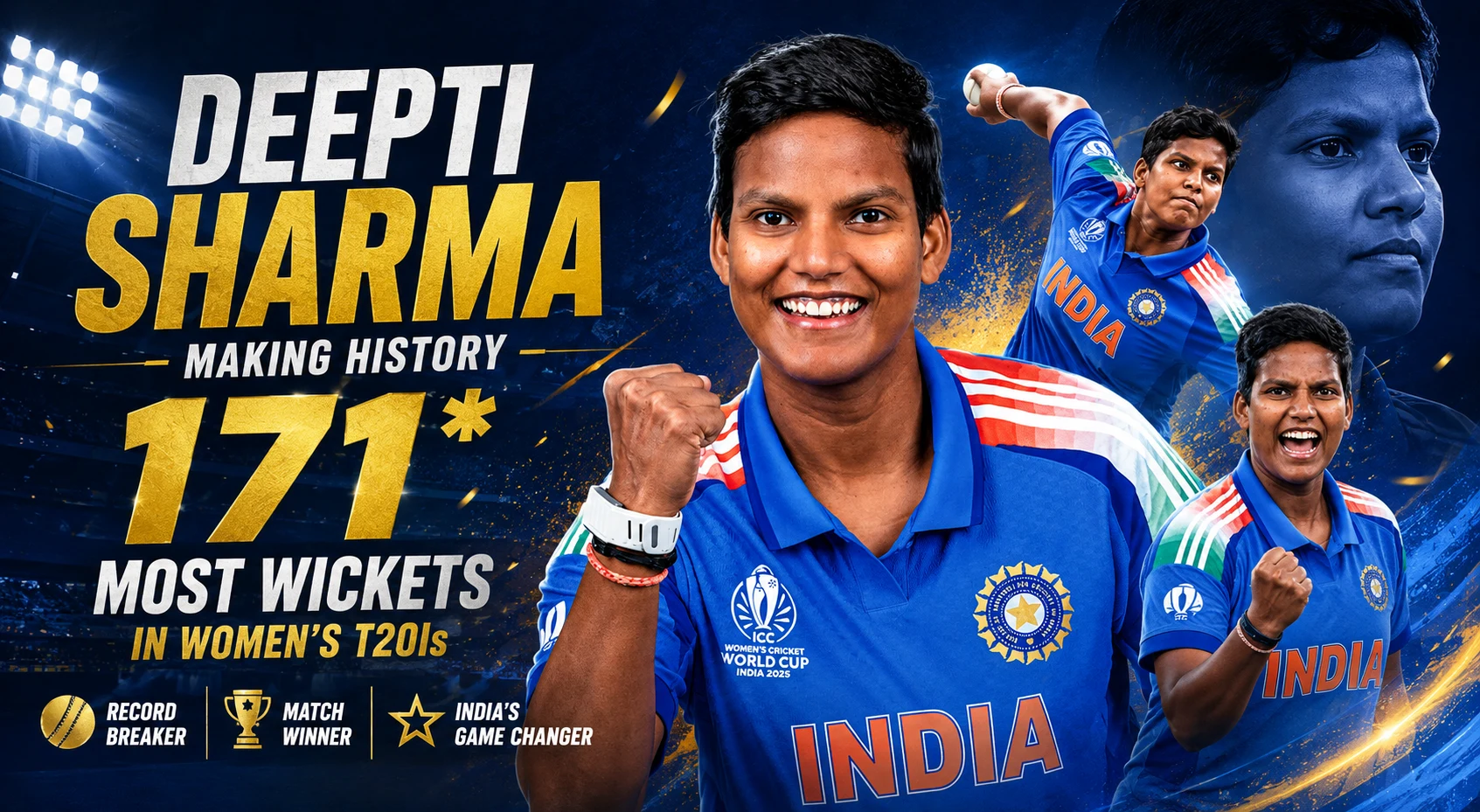
Deepti Sharma had already built a remarkable career for India, but her latest performance in Dubai added one of the biggest individual milestones yet to her name. Playing her 150th T20I for India, Deepti became the all-time leading wicket-taker in Women’s T20I cricket, reaching 171 wickets during India’s 94-run victory over Thailand in the opening match of the Women’s T20 Asia Cup 2026. Her numbers were even more striking: 3 wickets for no runs from just 1.1 overs. The record-breaking bowling performance came after Shafali Verma’s explosive 64 off 36 balls, which gave India a flying start before Thailand’s spinners dragged the seven-time champions into a late batting collapse. India eventually posted 159/9 and then bowled Thailand out for only 65 in 16.1 overs, winning the match by 94 runs. Deepti Sharma’s World Record: 171 Women’s T20I Wickets The biggest story from the match was undoubtedly Deepti Sharma’s record. Before the game, Thailand’s Thipatcha Putthawong held the top spot with 170 wickets. Deepti entered the match on 168 wickets and needed only three wickets to move clear at the top. She did exactly that. Deepti first struck twice during Thailand’s chase, taking her level with Putthawong at 170. She then returned later in the innings and picked up her third wicket with her very first delivery of the spell. That took her career tally to 171 wickets, making her the highest wicket-taker in Women’s T20I history. Most wickets in Women’s T20Is Rank Player Wickets 1 Deepti Sharma (India) 171* 2 Thipatcha Putthawong (Thailand) 170 3 Henriette Ishimwe (Rwanda) 164 4 Sophie Ecclestone (England) 154 5 Kary Chan (Hong Kong) 153 5 Onnicha Kamchomphu (Thailand) 153 Deepti’s tally after the Thailand match. What makes the achievement even more impressive is that Deepti reached the landmark while playing her 150th T20I. She became only the third Indian woman after Harmanpreet Kaur and Smriti Mandhana to reach 150 T20I appearances. This was not simply another appearance for Deepti. It turned into a landmark night for Indian women’s cricket. Deepti Sharma’s Incredible 3/0 Spell Records are impressive, but the way Deepti reached this one was even better. Her final figures read: 1.1 overs, 1 maiden, 0 runs, 3 wickets. Yes, Thailand could not score a single run from Deepti’s seven deliveries while losing three wickets. It was the sort of spell that completely changed the mood of the chase. Deepti’s first two wickets came in the ninth over as Thailand slipped further into trouble. When she returned later in the innings, she needed only one ball to complete her three-wicket haul. The 3/0 figures also became a landmark in Indian women’s T20I cricket, with reports noting it as the first such three-wicket haul without conceding a run by an Indian player in the format. That is what made Deepti’s performance more than just a statistical achievement. She was directly responsible for Thailand’s batting collapse. Shafali Verma Provides the Perfect Start Before Deepti’s record-breaking spell, Shafali Verma had already given India the platform they needed. The opening batter played the kind of aggressive innings that has become her trademark, smashing 64 from only 36 deliveries. Her innings included: Shafali attacked from the beginning and helped India move beyond the 100-run mark inside 10 overs. At that stage, India looked on course for a score well above 200. Smriti Mandhana also contributed 19 from 10 balls before being run out, but Shafali was the main reason India gained such momentum during the powerplay and early middle overs. Her aggressive approach was exactly what India needed against Thailand. Thailand Fight Back With the Ball Despite India’s excellent start, the match was not completely one-sided. Thailand’s bowlers produced an impressive fightback in the second half of India’s innings. Leg-spinner Suleeporn Laomi was particularly effective, finishing with 3/26. She dismissed Shafali and Richa Ghosh in successive deliveries, helping trigger a dramatic Indian collapse. India went from 108/2 to 137/9, losing seven wickets for only 29 runs. That collapse is probably the biggest concern India will take from the match. A team of India’s quality would have expected to finish much closer to 190 or 200 after reaching 108/2. Instead, Thailand’s spinners found a way back into the contest. India eventually finished at 159/9. It was a competitive total rather than a huge one, but India’s bowling attack quickly showed why Thailand still had a mountain to climb. India’s Powerplay Strategy Worked, But the Finish Needs Attention India’s batting approach in the opening overs was clear: attack early, put pressure on the opposition and take advantage of the fielding restrictions. Shafali’s 64 was the biggest reward for that approach. India raced past 100 in the first 10 overs, creating the foundation for a potentially massive total. But the collapse after Shafali’s dismissal exposed an issue India will want to fix before facing stronger opponents. Against Thailand, the bowling unit was good enough to cover for the batting stumble. Against teams such as Pakistan, Bangladesh or defending champions Sri Lanka, India may not get the same luxury. The lesson is simple: the aggressive start has to be followed by a controlled finish. Thailand Never Really Recovered in the Chase If India’s batting collapse gave Thailand some hope, their own innings quickly removed it. Thailand were bowled out for just 65 in 16.1 overs. Deepti was the headline act, but she was not alone. India’s spin and pace combination kept the pressure on throughout the innings, with the Thai batters struggling to build partnerships. Once Deepti began taking wickets, the required rate became irrelevant because wickets were falling too quickly. The final margin of 94 runs underlined India’s dominance with the ball. For India, this was an ideal response after the batting wobble. For Thailand, it was a reminder of the gap between the two sides, although their bowlers can take some confidence from the way they disrupted India’s middle order. Why Deepti Sharma’s Record Matters There is something particularly fitting about Deepti Sharma becoming the leading wicket-taker. She has never

Duleep Trophy 2026 Semi-Finals Preview: Gurnoor Brar’s Return and Vaibhav Sooryavanshi in the Spotlight
The Duleep Trophy has reached the stage where there is very little room for error. Four teams remain, two places are available in the final, and the attention is beginning to shift from simply winning a zonal contest to what these matches could mean for the future of Indian red-ball cricket. The 2026 Duleep Trophy semi-finals will be played at the BCCI Centre of Excellence in Bengaluru, with East Zone taking on Central Zone and North Zone facing South Zone. There is plenty to watch in both games. East Zone have arrived after a commanding quarter-final victory, with teenage batting sensation Vaibhav Sooryavanshi once again attracting most of the attention. On the other side, Central Zone have the experience and balance to test him in conditions that demand patience. The second semi-final has its own major storyline. Gurnoor Brar returns to North Zone after being part of India’s Test setup, giving him an important opportunity to get more red-ball cricket under his belt. His contest against South Zone’s experienced batting group could be one of the most interesting battles of the match. For the players involved, this is about much more than reaching a domestic final. These are the kind of matches where performances can influence the next India A squad, future Test selections and the wider red-ball plans of Indian cricket. Duleep Trophy 2026 Semi-Finals: What Is at Stake? The Duleep Trophy has traditionally been an important platform for players trying to move closer to the Indian Test side. That role has become even more significant as the domestic calendar continues to produce a steady stream of young talent. The semi-finals provide four teams with a chance to play against stronger opposition while handling the pressure of a knockout match. There is also an obvious individual angle. A batter who makes a hundred here, a fast bowler who produces a five-wicket haul or an all-rounder who controls a game can quickly find his name entering selection conversations. For the younger players, it is an opportunity to show that their game can survive when the opposition gets stronger. For established players, it is a chance to remind selectors that they are still ready. And for players coming back from international duty, it is about maintaining rhythm. That makes this year’s semi-finals particularly interesting. East Zone vs Central Zone: Youth Meets Experience East Zone enter their semi-final with plenty of confidence after their dominant quarter-final performance against North East Zone. They won that match by an innings and 210 runs, putting themselves firmly into the last four. Now the challenge is considerably tougher. Central Zone have a well-balanced side and enough experience to make East Zone work for every run. The biggest individual storyline, however, is obvious. Vaibhav Sooryavanshi. The 15-year-old has already spent most of 2026 breaking records, but the Duleep Trophy offers him a completely different examination. This is red-ball cricket. There is no powerplay. There are no fielding restrictions forcing captains to keep men inside the circle. A batter cannot simply rely on attacking the first few overs. The bowlers can build pressure over long spells, change their lines, set fields specifically for one batter and wait for mistakes. For Vaibhav, that makes this match an important part of his development. Vaibhav Sooryavanshi’s Red-Ball Test There is no doubt about Vaibhav’s ability to dominate white-ball cricket. His 2026 IPL season was extraordinary, and his performances for India at the senior level have already created enormous attention. But red-ball cricket asks different questions. Can he leave the ball outside off stump? Can he bat for 100 or 150 balls without feeling the need to attack? Can he recover after losing an early wicket? Can he score when the boundary options are limited? Those are the questions Central Zone’s bowlers are likely to ask. The answer will not come from one innings. But every long stay at the crease will add something to his education. Why This Match Matters for Vaibhav It would be easy to look at Vaibhav’s age and simply treat this match as another opportunity for a teenager to gain experience. But he has already moved beyond that stage. The expectations around him are now enormous. He has played international cricket. He has scored hundreds in the IPL. He has dominated Under-19 cricket. That means the next part of his journey is learning how to handle situations where the game does not suit his natural attacking instincts. A patient 80 could tell us as much about his development as another quick hundred. In fact, it might tell us more. Central Zone Have the Tools to Challenge East Zone Central Zone will not be interested in Vaibhav’s age or reputation. Their job will simply be to get him out. That could mean attacking him early with the new ball before he gets settled, or using changes of pace and spin once he begins to dominate. Central Zone’s experienced players also give them the ability to absorb pressure. That could become important if East Zone start strongly. In knockout cricket, momentum can change quickly. A team can dominate for two sessions and suddenly find itself under pressure after losing three wickets. Central Zone’s ability to stay in the game could therefore be just as important as their ability to take wickets. East Zone’s Biggest Strength: Momentum East Zone have already shown what they can do when their players get on top. Their quarter-final victory was emphatic. The bowling attack put North East Zone under constant pressure, while the batting lineup gave the bowlers plenty of room to work with. Now they have to reproduce that intensity against a stronger opponent. The semi-final will also test whether their younger players can maintain their composure when the match becomes tight. A four-day knockout game can change direction several times. East Zone will need patience. They cannot afford to chase the game if Central Zone begin well. North Zone vs South Zone: Gurnoor Brar Returns The second semi-final has perhaps the
Vaibhav Suryavanshi: From a Small Town in Bihar to India’s Youngest International Cricketer
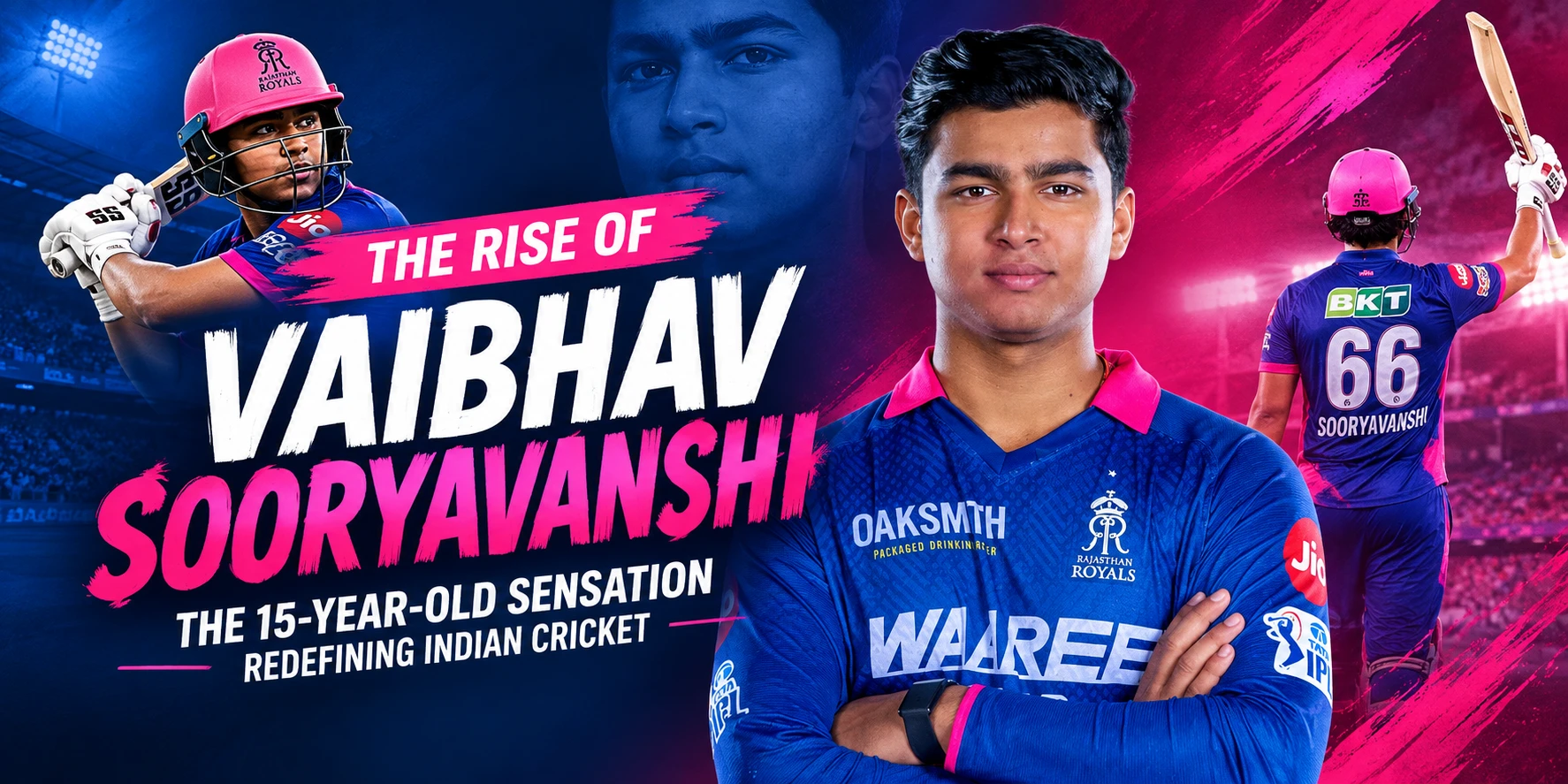
There are plenty of young cricketers who are called “the next big thing”. Very few actually live up to the noise around them. Vaibhav Suryavanshi is already taking a different route. At just 15 years old, the left-handed batter from Bihar has already played first-class cricket, represented India at Under-19 level, won an IPL contract, made his IPL debut, scored a century in the IPL, starred in an Under-19 World Cup final, won the IPL Orange Cap, played for India A and then became the youngest player ever to represent India in men’s international cricket. And somehow, his story is still only beginning. Born on March 27, 2011, in Tajpur, Bihar, Vaibhav has travelled an extraordinary distance in a very short period. His journey is not simply about the huge sixes or the records. Behind those headlines is a story of early training, family support, domestic cricket, coaches who worked on his basics and a teenager who has repeatedly been willing to test himself against players much older than him. As of August 30, 2026, Vaibhav is playing the Duleep Trophy for East Zone, adding another chapter to a career that has already moved through several levels of Indian cricket. His first Duleep Trophy match did not go according to plan with the bat, but he responded by taking two wickets with his left-arm spin. East Zone then reached the semi-finals, where they face Central Zone on August 30. This is the story of how he got here. Growing Up in Bihar Vaibhav Suryavanshi comes from Tajpur in Samastipur district of Bihar. His cricket journey began unusually early. His family noticed his interest in the game when he was still a very young child, and his father played an important role in supporting that ambition. The early years were not glamorous. There were long journeys for training, repeated practice sessions and the sort of routine that slowly builds a young cricketer’s game. His coach, Manish Ojha, has spoken about how much attention was given to fundamentals rather than simply trying to turn Vaibhav into a power-hitter. The work included the cut, upper-cut, pull and drive, along with footwork and head position. That detail matters because it gives a different picture of Vaibhav. The teenager who now hits sixes at extraordinary rates did not simply arrive with raw power. There was considerable work on his basic technique before the big stages came calling. His father remained closely involved throughout those early years. Even after Vaibhav became an IPL player, one of the first people he wanted to call after his historic IPL century was his father. That small moment said a lot about the relationship behind the cricket career. A Boy Who Wanted to Play Against Bigger Challenges What separated Vaibhav from many young players was his willingness to play against older opposition. Rather than spending all his formative years only in age-group cricket, he was exposed to senior cricket remarkably early. That eventually led him into Bihar’s domestic setup. And then came a moment that changed the way people looked at him. Ranji Trophy Debut at 12 In January 2024, Vaibhav made his first-class debut for Bihar against Mumbai in the Ranji Trophy. He was only 12 years and 284 days old. That made him the second-youngest player to appear in the Ranji Trophy. The match itself was not a fairy-tale batting performance. Against a strong Mumbai side, Vaibhav scored 19 in the first innings and 12 in the second. Bihar were bowled out for 100 in both innings and suffered an innings defeat. But the importance of the match was not really about the numbers on the scoreboard. He had entered senior first-class cricket while still a child. The experience exposed him to bowlers with years of professional cricket behind them. It also gave him a taste of the demands of red-ball cricket, something that would become an important part of the discussion around his development later. 2024: The Year Everything Started Moving Quickly If the Ranji Trophy debut introduced Vaibhav to senior cricket, 2024 was the year he began making an international name for himself. He became part of India’s Under-19 setup and soon found himself playing against Australia Under-19. In October 2024, he produced one of the innings that first made international cricket sit up and take notice. The 58-Ball Century Against Australia U19 Playing in a Youth Test against Australia Under-19 in Chennai, the 13-year-old smashed 104 from just 62 balls. His century came in only 58 balls. It was the fastest century by an Indian batter in Youth Tests at the time and the second-fastest overall, behind Moeen Ali’s 56-ball hundred from 2005. Vaibhav’s innings included five sixes and 14 fours. This was a different kind of statement. It was not a domestic age-group tournament. It was India against Australia, and Vaibhav was taking on an international youth attack with an attacking style that would soon become his trademark. The innings also helped establish something that has followed him ever since: Vaibhav does not seem particularly interested in waiting for the game to come to him. He wants to attack. The IPL Auction: Rajasthan Royals Take the Gamble Only a few weeks after his Australia U19 century, Vaibhav’s career took another huge turn. The 2025 IPL auction was held in November 2024. At 13, Vaibhav became the youngest player ever to be sold at an IPL auction. Rajasthan Royals bought him for ₹1.10 crore. That was a huge moment for a teenager who had only recently begun appearing on the wider cricket radar. The Royals had seen enough during his trials to believe that his game could translate to the IPL. The decision also reflected Rajasthan’s long-standing willingness to invest in young players. The franchise had previously backed players such as Sanju Samson, Yashasvi Jaiswal and Riyan Parag at different stages of their development. Vaibhav became the next teenage project, except that his age made the signing extraordinary even by IPL standards. For Vaibhav,
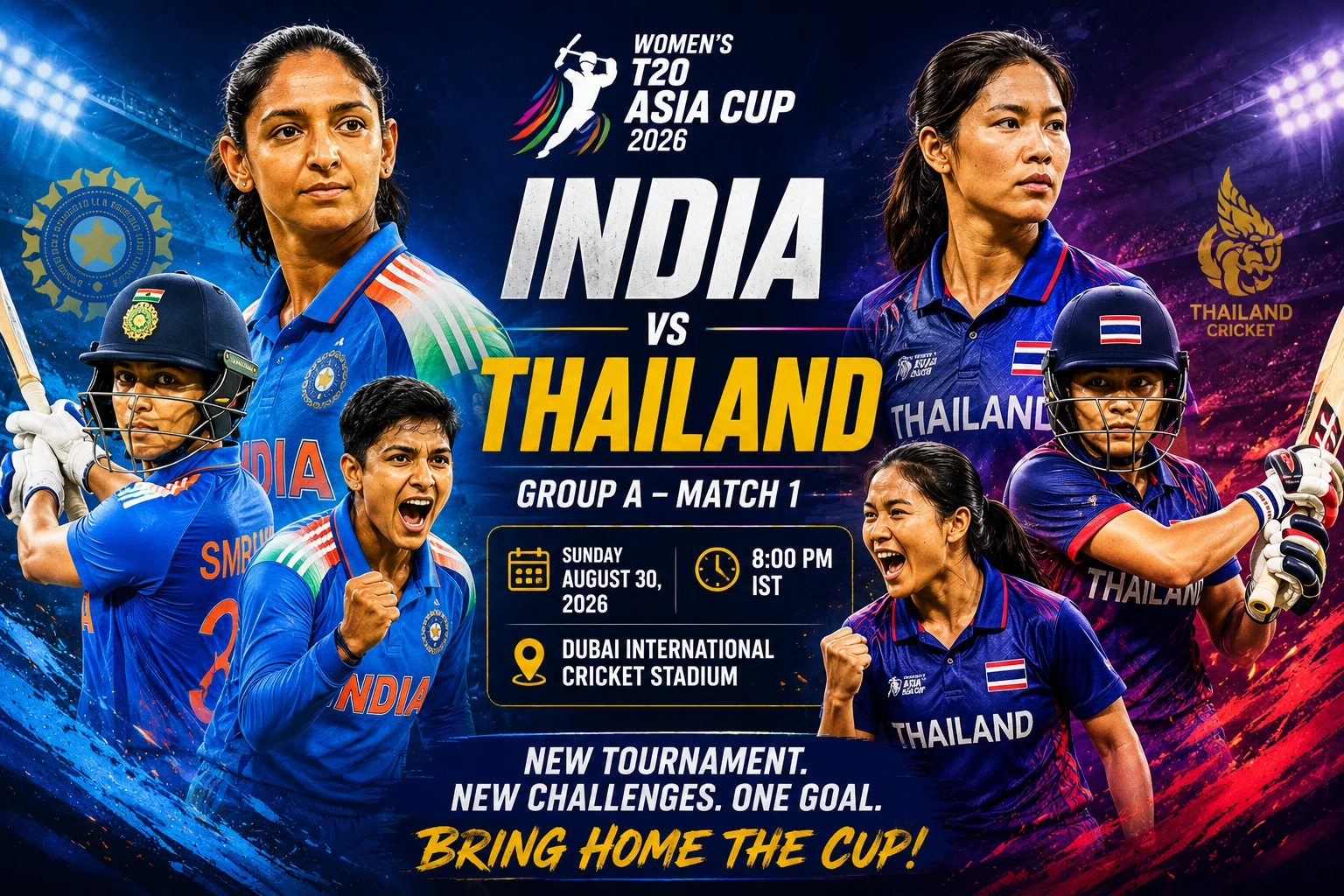
Women’s T20 Asia Cup 2026: India vs Thailand in Dubai
India Women begin their Women’s T20 Asia Cup 2026 campaign against Thailand Women on Sunday, August 30, at the Dubai International Stadium. The match is scheduled for 8:00 PM IST and will be India’s first Group A fixture of the tournament. On paper, India enter the contest as clear favourites. They have greater experience, a deeper batting lineup and several players who have spent years playing at the highest level. But Thailand have already shown in the opening game that they are not simply here to make up the numbers. They beat Hong Kong, China by six runs in a closely fought match, giving themselves an early boost in Group A. For India, though, this match is about more than just getting two points. The team will want a strong start and, perhaps more importantly, some confidence in their T20 game after an inconsistent run. India vs Thailand: Match Overview The defending champions begin their campaign with a matchup that looks favourable on paper. India have won three of the five Women’s Asia Cup editions played in the T20 format, and they are once again among the leading contenders for the trophy. Harmanpreet Kaur will lead a side packed with familiar names. Smriti Mandhana, Shafali Verma, Deepti Sharma and Richa Ghosh give India experience in all three departments, while the squad also has younger players capable of making an impact. Thailand, meanwhile, arrive with some momentum. Their six-run win over Hong Kong was not a one-sided affair. They had to defend 120, and their bowlers managed to hold their nerve when Hong Kong threatened to chase the target. That result should give Thailand plenty of belief going into their second game. India will therefore be expected to control the match, but Thailand’s disciplined bowling could make the contest more interesting than the rankings might suggest. India’s Big Advantage: Top-Order Batting If India are to dominate this game, much of the pressure will fall on their opening pair. Smriti Mandhana and Shafali Verma give India two very different styles at the top. Mandhana can build an innings with timing and placement, while Shafali has the ability to change the game within a few overs by taking on the bowlers. That combination is particularly dangerous in the T20 format. If India get a fast start in the powerplay, Thailand could quickly find themselves defending against a scoreboard that is already moving beyond their comfort zone. The bigger advantage for India is what comes after the openers. Richa Ghosh provides genuine finishing ability, while Deepti Sharma brings both batting depth and experience. Harmanpreet Kaur also remains an important figure in the middle order, particularly when India lose an early wicket and need someone to steady the innings before accelerating again. India do not necessarily need one batter to score a huge individual hundred. Their strength is the number of players capable of contributing meaningful runs. Pratika Rawal Gets an Important Opportunity One of the major talking points around India’s squad is the absence of Jemimah Rodrigues. Rodrigues has been ruled out of the Asia Cup after suffering a high-grade right hamstring tear while playing in The Hundred. The BCCI subsequently named Pratika Rawal as her replacement. It is an unfortunate absence for India because Rodrigues has been an important part of their T20 setup. For Rawal, however, this represents a valuable opportunity. The replacement is not simply about filling a vacant squad position. India need someone who can provide stability in the middle order while still keeping the scoring rate moving. Rawal’s inclusion gives the team another option as they work out the best combination for the tournament. With three group matches before the knockout stage, India also have some room to experiment with combinations. Thailand’s Spin Challenge Thailand’s biggest hope will probably be to make India’s batters work hard during the middle overs. Their bowling attack does not have the same pace resources or international experience as India, so variations and disciplined lines will be important. Thipatcha Putthawong and Suleeporn Laomi are among the bowlers Thailand will look towards to slow India’s scoring. The idea will be fairly simple: avoid giving the Indian batters easy boundaries and force them to take risks. This could become particularly important if Thailand can restrict India during overs 7 to 15. India’s top order may be able to dominate the powerplay, but if Thailand can introduce spin effectively and pick up wickets in the middle, the pressure can shift quickly. That is probably Thailand’s best route into the game. Thailand Have Already Shown Fighting Spirit Thailand’s opening match against Hong Kong should not be overlooked. They posted 120/9 and then defended the total successfully, with Hong Kong finishing on 114/7. A six-run victory might not sound huge, but defending a modest total requires good bowling discipline and composure. That result means Thailand enter this match with something India do not necessarily have at the same stage: a win already on the board. They will also have a better understanding of how the Dubai surface is behaving under match conditions. Thailand know they cannot compete with India simply by trying to out-hit them. Their best chance is to turn the game into a contest of patience, particularly through the middle overs. Dubai Pitch and Weather: What Could Matter? The Dubai International Stadium will host every match of the 2026 Women’s Asia Cup, making familiarity with the conditions important throughout the tournament. The surface generally offers enough bounce for stroke-making, but conditions can change as the evening progresses. The toss could therefore have some significance. With the match being played under floodlights, dew could make the ball harder to grip later in the evening. If that happens, chasing may become the more attractive option. For the spinners, the key will be getting their work done before the conditions become too difficult. Thailand, in particular, will want to use their slow bowlers at the right moments rather than simply saving them for the end. India’s bowling attack will
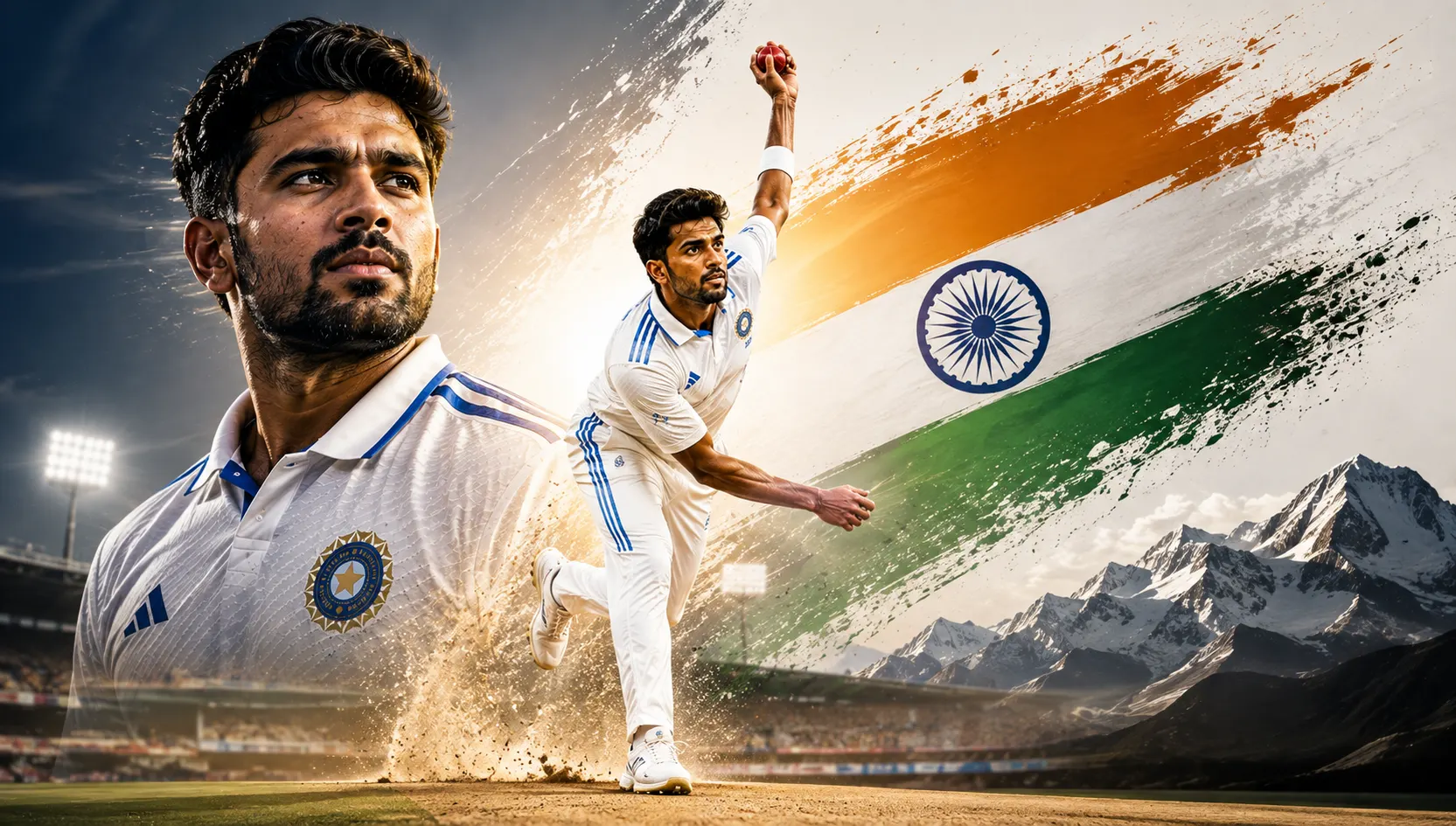
Auqib Nabi in the Test Squad: Why the Fast Bowler is India’s Next Red-Ball Sensation
For a player who had spent years waiting for his chance, Auqib Nabi’s India call-up came in a rather unexpected way. He was not part of the original Test squad for the Sri Lanka tour. He was actually on his way to the BCCI Centre of Excellence when a phone call changed his plans. Jasprit Bumrah had been ruled out of the series because of his ongoing left-knee problem, and suddenly Nabi was on his way to Sri Lanka as his replacement. The timing may have been unexpected, but the selection itself was hardly a surprise. For the last two Ranji Trophy seasons, Nabi has been doing almost everything a fast bowler can do to get noticed. He took 104 wickets across the 2024-25 and 2025-26 seasons, including an extraordinary 60 wickets in the 2025-26 campaign. Those performances played a major role in Jammu & Kashmir winning their first-ever Ranji Trophy title. Now, at 29, the Baramulla-born pacer is standing on the edge of Test cricket. He has already made history as the first cricketer from Jammu & Kashmir to receive a call-up to India’s senior Test squad. And there is a lot more to his story than the numbers. From waiting for a call to finally getting one Nabi’s journey is interesting partly because the call-up did not come when many expected it. His 60-wicket Ranji season was impossible to ignore. He finished as the competition’s leading wicket-taker and was a central figure in Jammu & Kashmir’s historic title run. He took five-wicket hauls in the quarter-final, semi-final and final, finishing the season with eight five-wicket hauls. Yet when India’s original Test squad for Sri Lanka was announced, Nabi’s name was missing. That could have been frustrating. Instead, he carried on. Nabi later admitted that he expected an India call-up at some point because of the performances he had been putting together. His approach was simple: keep taking wickets and let the selectors make the decision. That attitude says quite a lot about the bowler. He was not waiting around for somebody to hand him an opportunity. He was trying to make himself impossible to ignore. Eventually, Bumrah’s injury opened the door. Nabi was ready to walk through it. The numbers behind the hype The easiest way to understand why Nabi’s name has become so prominent is to look at his first-class record. He has taken 162 wickets in 43 first-class matches, with a bowling average of 18.63 and a strike rate of 38.5. He has also taken 16 five-wicket hauls and four 10-wicket matches. Then came the last two Ranji seasons. 2024-25: 44 wickets 2025-26: 60 wickets Two-season total: 104 wickets The second figure is particularly impressive. His 60 wickets in 2025-26 were the highest in the tournament, and ESPN’s statistical review placed the haul seventh among all bowlers in a single Ranji Trophy season and third among fast bowlers. Only Jaydev Unadkat’s 67 in 2019-20 and Dodda Ganesh’s 62 in 1998-99 were higher among Ranji seamers. That is not a hot streak over a handful of matches. It is sustained red-ball production. And that is exactly what makes Nabi such an interesting prospect for Test cricket. He has built his reputation the old-fashioned way There is something refreshing about Nabi’s rise. He has not been picked because of one spectacular spell in a franchise tournament. His reputation was built over four-day cricket. Long spells. Hard wickets. New-ball bowling. Old-ball bowling. Bowling when the conditions are helpful and, perhaps more importantly, when they are not. That matters because Test cricket asks very different questions of a fast bowler. You cannot simply bowl four overs, give everything you have and walk off. You may need to bowl 15 overs in an innings. Then another 10. Then come back the following day. You have to maintain your line when your legs are tired. You have to understand when to attack the stumps and when to make the batter play away from his body. Nabi’s first-class background suggests he has already spent plenty of time learning those lessons. His 60-wicket season was the real turning point Jammu & Kashmir’s Ranji Trophy triumph was historic in itself. But Nabi was the driving force behind much of it. He finished the 2025-26 season with 60 wickets and was named Player of the Tournament. His five-wicket haul in the final against Karnataka took him to the top of the wicket-taking charts. What made the season special was the consistency. He was not taking five wickets once every few months. He kept coming back with important spells. When J&K needed to win a knockout match, Nabi delivered. When the team needed an early breakthrough, he delivered. When the opposition had settled into a partnership, he found a way to break it. That is exactly the sort of reliability selectors look for in a red-ball fast bowler. He has already had a taste of international-level cricket Another reason Nabi’s Test call-up makes sense is that he had already been around the India A setup. He was part of the India A tour of Sri Lanka earlier this year and took six wickets in two first-class matches. That experience was useful for more than the wickets. He got to bowl in Sri Lankan conditions. He got to see how the pitches behaved. He experienced the heat and humidity. And he spent time around players and coaches operating just below the senior international level. One of his more useful performances came in the unofficial Test, where he took a four-wicket haul. So when the India call finally came, Nabi was not travelling into completely unfamiliar territory. He had already spent time in the country. He knew what to expect. What kind of bowler is Auqib Nabi? Nabi is a right-arm fast bowler whose biggest strength appears to be his ability to create pressure through consistency. That might not sound as exciting as saying a bowler is lightning quick or produces outrageous swing. But Test cricket has always

Women’s T20 Asia Cup Dubai 2026: Full Schedule, India Squad, and Title Defense Preview
India will head to Dubai at the end of August with something to prove. The Women’s T20 Asia Cup 2026 begins on August 28, and Harmanpreet Kaur’s side will be looking to bring the trophy back after missing out in the previous edition. The tournament will be played entirely at the Dubai International Cricket Stadium, with eight teams competing for the continental title. There is one small correction worth making at the start: India are not the defending champions this time. Sri Lanka are. Sri Lanka won their maiden Women’s Asia Cup title in 2024 by beating India in the final. India, however, remain the most successful team in the tournament’s overall history, with seven titles across the ODI and T20 eras. In the T20 format specifically, India have won three editions 2012, 2016 and 2022. So the story heading into Dubai is not about India defending their crown. It is about India trying to reclaim it. And after a disappointing T20 World Cup campaign earlier this year, this tournament has arrived at an interesting time for Harmanpreet’s team. Women’s T20 Asia Cup 2026: At a Glance The tournament will run from August 28 to September 13, with all 15 matches taking place at the Dubai International Cricket Stadium. Eight teams have been divided into two groups, with the top two from each group advancing to the semi-finals. Details Information Tournament Women’s T20 Asia Cup 2026 Dates August 28 – September 13 Venue Dubai International Cricket Stadium Teams 8 Format T20 International Defending champions Sri Lanka Most successful team India – 7 overall titles India captain Harmanpreet Kaur India vice-captain Smriti Mandhana Final September 13 The group stage will be followed by semi-finals on September 10 and 11, with the final scheduled for September 13. All matches are scheduled under lights, starting at 6:30 PM local time in Dubai, which is 8:00 PM IST. India Have a Point to Prove India’s recent T20 story has been a mixture of good signs and frustrating results. The team went into the 2026 T20 World Cup with genuine expectations after winning the 2025 Women’s ODI World Cup and beating Australia in a T20I series earlier in the year. Smriti Mandhana spoke before the World Cup about carrying that confidence into the tournament and believed India’s improving power-hitting could make the side more dangerous in the shortest format. The World Cup, however, did not go India’s way. They were knocked out in the group stage after losing their must-win final group match against Australia at Lord’s. Australia chased down India’s 170/4 with six wickets in hand, ending India’s hopes of reaching the semi-finals. That result will still be fresh in the players’ minds. But there is a positive way of looking at it. The Asia Cup gives India a chance to start again. This is a shorter tournament, the opposition is familiar and there is no room for a long losing run. India have to get their combinations right quickly. India Are in Group A India have been placed in Group A alongside Pakistan, Thailand and Hong Kong, China. Group B consists of Sri Lanka, Bangladesh, UAE and Indonesia. On paper, India should be one of the favourites to finish in the top two. But the group-stage match everyone will immediately circle on the calendar is obvious. India vs Pakistan — September 5. It is only a group match, but India-Pakistan games rarely feel like ordinary group matches. India Women’s Asia Cup 2026 Full Schedule India have three group-stage matches before the knockout phase. Date Match Venue Time (IST) August 30 India Women vs Thailand Women Dubai 8:00 PM September 3 India Women vs Hong Kong, China Women Dubai 8:00 PM September 5 India Women vs Pakistan Women Dubai 8:00 PM India’s opening game is against Thailand on August 30, followed by Hong Kong, China on September 3. Then comes the big one against Pakistan on September 5. If India take care of those three games, they should be in a strong position heading into the semi-finals. But the Pakistan match could have a major bearing on who finishes top of Group A. India vs Pakistan Could Set the Tone The September 5 clash is easily the biggest group-stage fixture of the tournament. Pakistan are also in Group A, and their squad will be led by Fatima Sana, who returns as captain after missing Pakistan’s recent T20I series against Sri Lanka because of her commitments in The Hundred. Pakistan have never won the Women’s Asia Cup, but they have reached the final twice, in 2012 and 2016, losing both times to India. This time, they have a chance to make a statement against a team that is still trying to find its best T20 combination. India will start favourites, but Pakistan have enough individual quality to make the game uncomfortable if India lose early wickets. India’s Updated Asia Cup Squad The biggest selection story surrounding India’s squad is the absence of Jemimah Rodrigues. Jemimah suffered a high-grade right hamstring tear while playing for Southern Brave in The Hundred on August 3. The BCCI medical team confirmed the injury after assessing her at the Centre of Excellence, and she has been ruled out of both the Asia Cup and the Asian Games. Pratika Rawal has been named as her replacement for the Asia Cup. India’s 15-member squad is: It is a squad with plenty of experience, but there are also several younger players who could get important opportunities during the tournament. Jemimah’s Absence Changes India’s Batting Balance Jemimah’s injury is a genuine blow. She has been one of India’s most dependable middle-order batters and has the ability to play according to the situation rather than simply following one approach. Her absence means India will have to decide how they want to fill the gap. Pratika Rawal is the obvious replacement in the squad, but there are other options. Bharti Fulmali can provide another batting option, while Richa Ghosh offers attacking ability lower down the
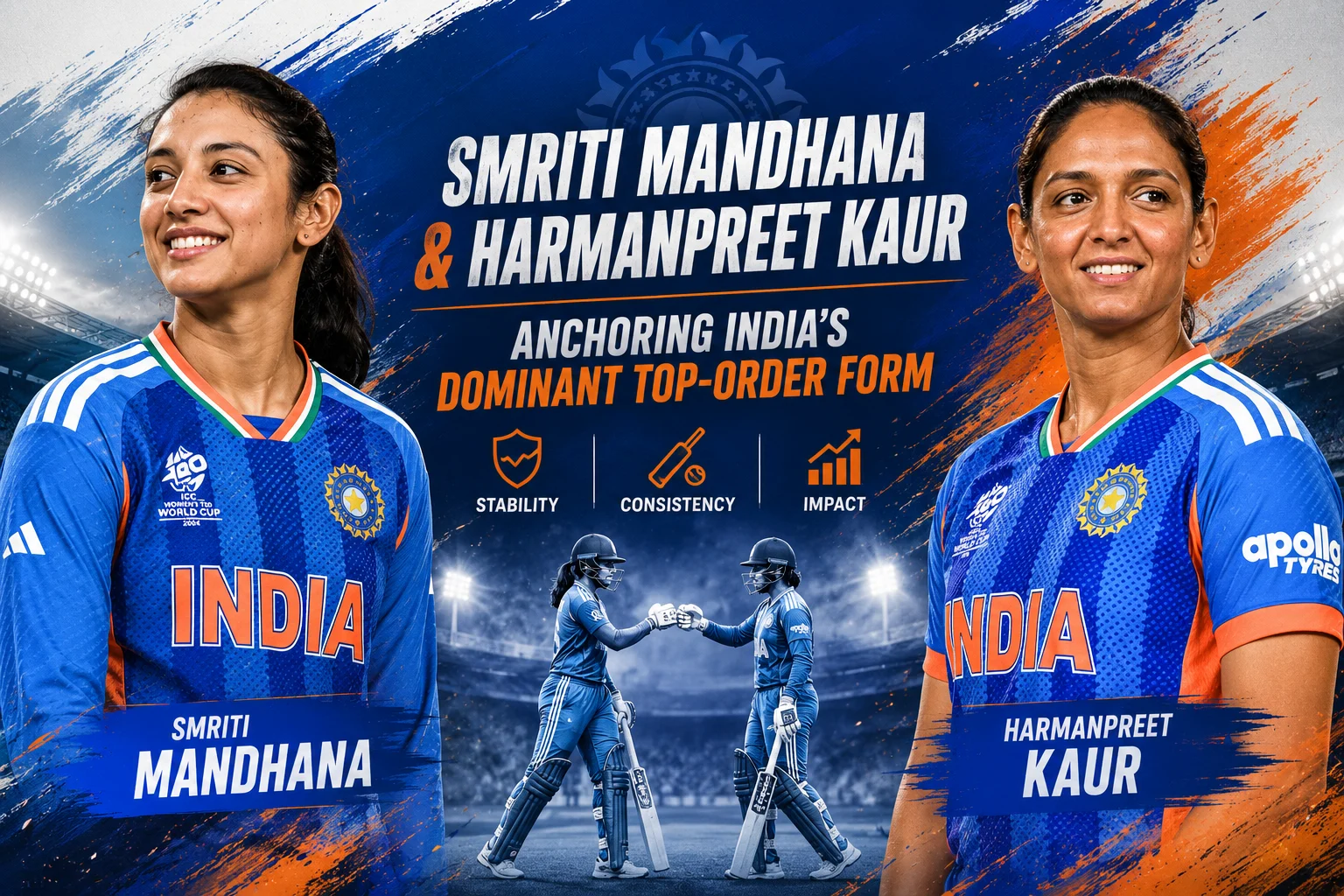
Smriti Mandhana & Harmanpreet Kaur: Anchoring India’s Dominant Top-Order Form
Indian women’s cricket has changed quite a bit over the last few years. There was a time when the team could be competitive for long periods but still depended heavily on one or two batters producing something special. Now the picture is different. India have more depth, more attacking options and, perhaps most importantly, two senior batters who continue to set the standard. Smriti Mandhana and Harmanpreet Kaur are at the centre of that change. They don’t bat in exactly the same role. Mandhana is the elegant left-handed opener who can take a game away from an opposition inside the powerplay. Harmanpreet usually comes in further down the order, where the game can demand something completely different from her. But together, they form the experienced batting core around which India’s top and middle order has been built. And the interesting thing about their current form is that it isn’t based on one tournament or one memorable innings. Mandhana has continued to produce runs across formats, while Harmanpreet has remained one of India’s most important big-match batters and leaders. Their contributions were visible again during India’s historic Test win at Lord’s, and both remain central to the team’s plans for the upcoming Asia Cup and Asian Games. With India preparing for another busy stretch of international cricket, the question isn’t whether these two players still matter. It is how much longer India can keep getting this level of influence from them. Mandhana and Harmanpreet are coming off very different summers The numbers tell an interesting story. During the 2026 Women’s T20 World Cup, Mandhana scored 205 runs at a strike rate of 140.41, while Harmanpreet made 141 runs at 131.78. India did not make the semi-finals after losing to South Africa and Australia, and Australia eventually won the tournament. So it would be wrong to describe India’s T20 World Cup campaign as dominant. It wasn’t. India had some very good moments, including a 95-run win over the Netherlands, but the defeats against South Africa and Australia ended their tournament early. Yet even in that disappointing campaign, Mandhana and Harmanpreet were among India’s more reliable batting options. That matters because international cricket isn’t judged only by the tournaments a team wins. The ability to keep producing runs when the team isn’t at its best is what separates established players from occasional performers. Mandhana remains India’s most natural tempo-setter There is still something different about watching Mandhana bat when she gets going. She doesn’t always need a lot of balls to change the mood of an innings. Her cover drive remains one of the cleanest shots in women’s cricket, but what has made her so effective in recent years is the way she has expanded her range without losing that natural timing. India have increasingly looked to attack earlier in T20 cricket, and Mandhana is perfectly suited to that approach. Her performance against the Netherlands at the 2026 T20 World Cup was a good example. She made 74 off 47 balls, helping India reach 209/5. More importantly, she and Shafali Verma put together a 115-run opening partnership, giving India control of the match almost immediately. That is the Mandhana role at its best. She doesn’t necessarily have to bat through the entire innings. If she gives India 60 or 70 quickly, the rest of the batting order can play with much more freedom. Her consistency isn’t limited to T20 cricket One of the most impressive things about Mandhana’s recent career is that her batting has travelled across formats. She remains ranked No. 1 in the ICC Women’s ODI batting rankings, with Harmanpreet also inside the top 10. The latest available rankings list Mandhana first with 790 rating points and Harmanpreet ninth with 652. That is significant because ODI cricket demands a different type of batting from T20. There are times when Mandhana needs to attack. There are also days when she needs to bat 30 or 40 overs and build an innings. Her recent Test performances have shown another side to her game. At Lord’s, she scored 83 in the first innings and 70 in the second, becoming only the fourth Indian woman to score fifty-plus in both innings of a Test. That was not a case of Mandhana simply playing her T20 game in a longer format. She batted for time. She absorbed pressure. And she still found scoring opportunities. That ability makes her much more valuable than simply being India’s attacking opener. Lord’s was a reminder of what both players bring The first-ever women’s Test at Lord’s was a landmark match for Indian cricket. India won by 270 runs, and Mandhana played an important role in setting the tone. She made 83 in the first innings, while Harmanpreet scored 58. Their contributions helped India reach 285 after being asked to bat first. It wasn’t a huge total by Test standards, but the important part was how India recovered from pressure. Mandhana gave the innings momentum. Harmanpreet then played the more patient role. That difference in approach is exactly why the two complement each other so well. Mandhana can get India moving. Harmanpreet can take over when the game enters its middle phase. And when both are contributing, India have a much stronger base for the batters that follow. Harmanpreet’s game has always been about timing Harmanpreet’s batting can sometimes be misunderstood because people remember the big sixes. That is understandable. She has built a reputation as one of the most powerful hitters in women’s cricket. But her importance to India is not only about hitting boundaries. She has become much more comfortable judging when to attack and when to stay at the crease. Her 58 at Lord’s came from 121 balls, which tells you everything about the situation. She did not try to force the game. She recognised that India needed someone to stay there and build the innings. That is a different version of Harmanpreet. And it is probably the version India need more often. The big shots are

Chennai Super Kings’ Next Transition: Top Candidates to Anchor CSK’s New Era
For almost two decades, Chennai Super Kings have had something most IPL teams would love to have: a very clear identity. The yellow shirt meant MS Dhoni. The team had a familiar core, a familiar coaching setup and a way of playing that rarely changed too much from one season to the next. That model worked for a remarkably long time. But cricket eventually catches up with every team. The 2026 season made that reality impossible to ignore. MS Dhoni did not play a single match, CSK finished eighth with 12 points, and the franchise is now preparing for another major change after Stephen Fleming’s long association with the team also came to an end. The interesting part is that CSK are not starting from zero. There are already signs of a new core. Ruturaj Gaikwad is still there. Sanju Samson has arrived. Dewald Brevis has shown his ability to change games. Ayush Mhatre has emerged as one of the most exciting young Indian batters in the squad. Noor Ahmad gives them a long-term spin option. The question is no longer simply “Who will replace MS Dhoni?” That is too narrow. The bigger question is: Who can become the face of Chennai Super Kings’ next era? And the answer may not be one player alone. CSK’s transition has already started The old CSK formula was built around experienced players. That approach became famously associated with the “Dad’s Army” tag, but it also delivered five IPL titles. The problem came when that experienced core stopped producing consistently. CSK finished seventh in 2024, then bottom of the table in 2025. The 2026 season brought another disappointing campaign, with the team finishing eighth and missing the playoffs for a third successive year. That forced the franchise to change direction. The 2026 squad contained a much stronger emphasis on youth, with players such as Ayush Mhatre and Dewald Brevis becoming important parts of the batting group. At the same time, CSK made one of the biggest moves of the auction by bringing Sanju Samson into the squad. That was not a small change. Samson arrived as an established IPL batter, a wicketkeeper and a former captain with years of leadership experience. Suddenly, CSK had another player who could potentially become part of their post-Dhoni identity. Ruturaj Gaikwad is still the first name in the conversation Before looking at anyone else, it is important to start with Ruturaj Gaikwad. He was handed the CSK captaincy before the 2024 season as the franchise began preparing for life beyond Dhoni. That transition did not happen overnight, and Gaikwad has remained the team’s captain through the difficult period that followed. There have been questions about his leadership. There have been questions about his batting. And there have been calls from former players for CSK to consider a different captain. But that does not mean his story with the franchise is over. Stephen Fleming publicly backed Gaikwad during the 2026 season, saying he was still learning and would eventually become a fine captain. That support matters. Fleming had worked closely with Gaikwad and understood the franchise’s long-term thinking better than most outsiders. The problem is that CSK cannot simply rely on potential forever. The next season will be important. Gaikwad’s biggest challenge is separating captaincy from batting This may actually be the most important part of the discussion. Gaikwad is at his best when he is simply concentrating on batting. His timing through the off side, his ability to play spin and his calm approach at the crease have made him one of CSK’s most important batters over the last few seasons. But captaincy adds another layer. Every tactical decision is questioned. Every loss becomes a leadership debate. Every poor innings brings questions about whether the captaincy is affecting his batting. That pressure can build quickly. There have already been calls for CSK to remove Gaikwad as captain and hand the job to Sanju Samson. Former CSK player Subramaniam Badrinath was among those to argue that such a move could allow Gaikwad to focus more heavily on his batting. But there is another way to look at it. Gaikwad is still young enough to grow into the job. If CSK believe in him, the answer may be to give him a proper run rather than constantly changing the captain. Sanju Samson has made the debate much more interesting This is where things get genuinely complicated for CSK. Sanju Samson’s arrival has given the franchise a player who ticks several boxes at once. He is an established Indian batter. He is a wicketkeeper. He has captained an IPL side. He has played high-pressure matches. And he is still young enough to be part of a long-term project. His first season in yellow also gave CSK plenty to like. Samson finished IPL 2026 with 477 runs in 14 matches, striking at 165.63, and scored two centuries. One of those was a spectacular 115 not out against Delhi Capitals, while he also made 101 against Royal Challengers Bengaluru. Those numbers make the captaincy discussion understandable. He is not being considered because of reputation alone. He has actually produced runs. Could Sanju Samson become CSK’s next captain? This is currently one of the biggest talking points around the franchise. There have already been reports suggesting that Samson is viewed as a serious long-term captaincy option for CSK. Former players have also pushed the idea. But it is important not to present the change as confirmed. Ruturaj Gaikwad remains the established CSK captain. There has been no official announcement that Samson will replace him for IPL 2027. So the sensible way to look at it is this: Samson is now a credible alternative. And his presence gives CSK something they did not have before a ready-made senior Indian leader who can take responsibility if the franchise decides Gaikwad’s captaincy experiment has run its course. That is a very different situation from simply finding another player at the auction. Samson’s batting may be his
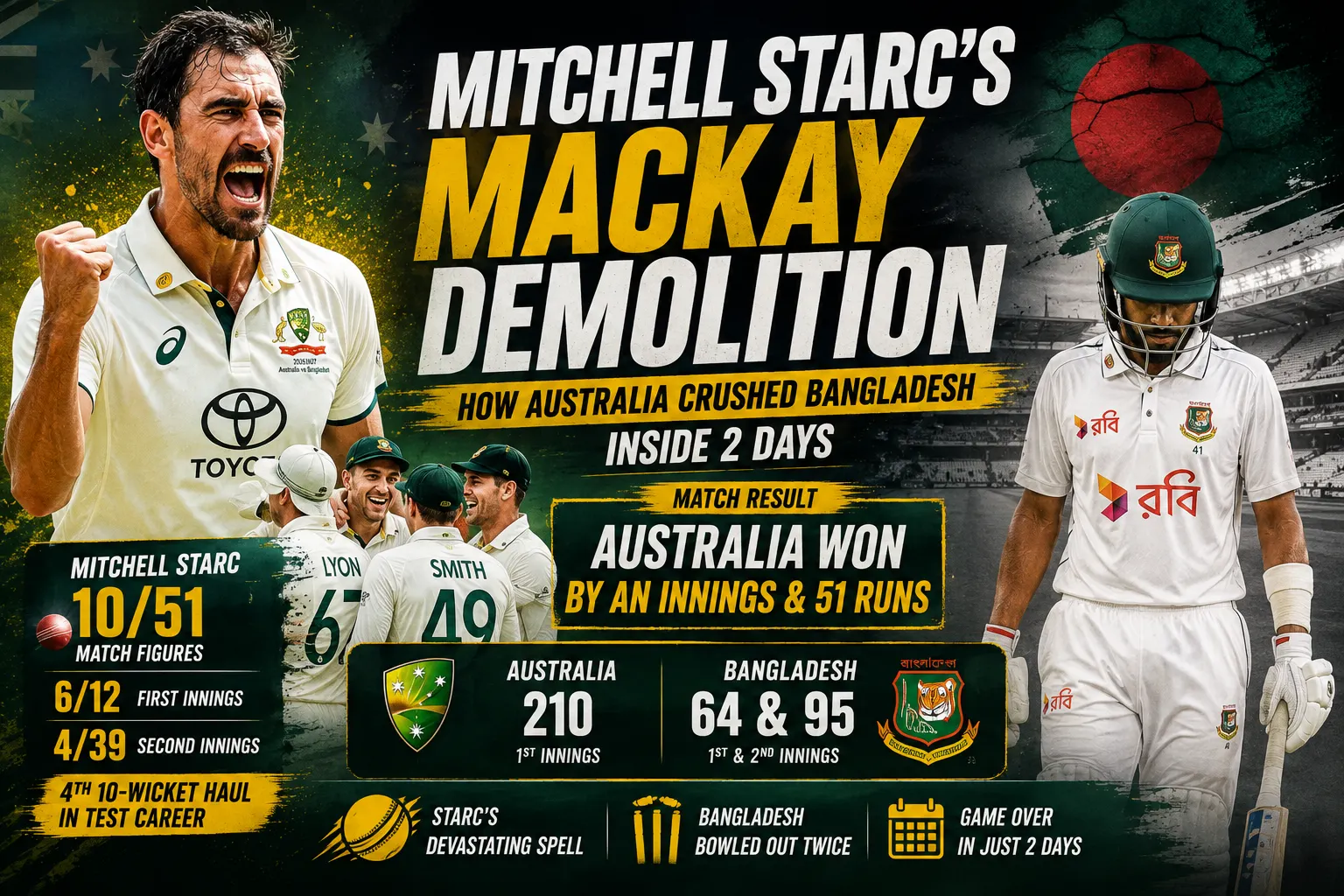
Mitchell Starc’s Mackay Demolition: How Australia Crushed Bangladesh Inside 2 Days
There was no slow start, no nervous finish and certainly no repeat of Darwin. Just two days after Bangladesh stunned Australia with one of the biggest wins in their Test history, Mitchell Starc and the Australian bowling attack turned the second Test at Mackay into a completely different contest. Australia beat Bangladesh by an innings and 51 runs, wrapping up the match inside two days and levelling the two-Test series 1-1. Bangladesh were bowled out for just 64 and 95, while Australia’s only innings produced 210. At the centre of it all was Starc. The left-arm quick finished with 10 wickets for 51 runs, taking 6/12 in the first innings and 4/39 in the second. It was the fourth 10-wicket match haul of his Test career and another reminder that, even at 36, Starc remains one of Australia’s most dangerous weapons when conditions suit him. Mackay was supposed to be Bangladesh’s chance to prove that the Darwin victory was no fluke. Instead, Australia responded with a statement. From Darwin Shock to Mackay Rout The turnaround could hardly have been more dramatic. Bangladesh had walked into the first Test in Darwin as underdogs and walked out nine-wicket winners. It was a historic result and, for Australia, a deeply uncomfortable one. They had been beaten by a Bangladesh side playing with confidence and discipline. The second Test began only a few days later. Australia needed a response. They got one almost immediately. Starc struck early and kept striking. Bangladesh’s top order had no answer to the combination of pace, movement and bounce. By the time the innings was over, the scoreboard read 64 all out. Suddenly, the pressure had moved entirely onto Bangladesh. And Australia never let it go. Starc Turned the First Innings Into a Personal Highlight Reel There are 10-wicket hauls, and then there are spells that feel like they are over before the opposition has had time to understand what is happening. Starc’s opening spell belonged to the second category. He finished with 6/12, and Bangladesh were reduced to 12/5 at one stage. Five of his wickets came in a devastating burst of just 22 balls. The damage wasn’t simply about raw pace. Starc was getting the ball to move. He was attacking the stumps. He was making Bangladesh’s batters play. And once wickets started falling, the Australian quicks sensed blood. That is when Starc is at his best. He doesn’t need much encouragement. Give him a pitch with bounce and movement, and suddenly every delivery feels like it could be the one that changes the innings. The Mackay Pitch Played Its Part It would be wrong to talk about this Test without discussing the surface. The Great Barrier Reef Arena produced a pitch with plenty of pace and bounce, and the ball moved enough to keep the batters under constant pressure. Starc himself acknowledged after the match that the pitch aided the bowlers. Bangladesh captain Najmul Hossain Shanto also admitted that the wicket was difficult for both teams’ batters. But there is an important detail here. Australia had to bat on exactly the same surface. And their batting wasn’t particularly comfortable either. Australia were bowled out for 210, with Cameron Green’s 67 the only score above 50. So this wasn’t simply a case of a perfect batting pitch suddenly turning into a minefield for Bangladesh. It was a difficult Test wicket. The difference was that Australia’s bowlers handled it better. Much better. Australia Didn’t Bat Brilliantly — They Didn’t Need To This is perhaps the strangest part of the match. Australia won by an innings despite making only 210. Usually, an innings victory comes after a huge first-innings total. Not this time. Australia were in serious trouble with the bat at various stages. Shoriful Islam was excellent for Bangladesh, taking a career-best 7/48 and becoming the first Bangladesh bowler to take seven wickets in a Test innings against Australia. But Cameron Green stood up when Australia needed somebody to stay there. His 67 proved extremely valuable. Nathan Lyon also made an important unbeaten 32, helping Australia build the 146-run first-innings lead that eventually proved more than enough. It wasn’t pretty batting. It was useful batting. And on a pitch like this, that can be enough. Cameron Green Quietly Played a Huge Role Starc will rightly dominate the headlines, but Cameron Green deserves plenty of credit. After scoring a century in Darwin, Green followed it with 67 in Mackay. That is exactly the sort of response Australia needed from him. His place in the side had come under scrutiny after a difficult Ashes campaign, and suddenly he has put together two meaningful scores in consecutive Tests. Captain Pat Cummins specifically praised Green’s batting after the Mackay win and said the performances should help his confidence. Green’s role becomes particularly important because Australia’s top order remains uncertain. If he can consistently provide runs at No. 5, it gives the team more freedom around the rest of the batting order. For now, he looks like one of the clear positives from the Bangladesh series. Shoriful Islam Had His Own Star Moment Bangladesh’s defeat shouldn’t completely overshadow what Shoriful Islam achieved. While Starc was destroying Bangladesh’s batting, Shoriful was doing almost the same thing to Australia’s. His 7/48 was the best innings haul by a Bangladesh bowler in an away Test. It was also his first five-wicket haul in Test cricket. That is a major milestone. He also had the unusual experience of sharing the field with Starc while producing a spell that had plenty in common with the Australian’s own performance. In a match where Bangladesh’s batting failed badly, Shoriful’s bowling gave them something to take home. And his battle with Starc was one of the few genuinely even contests in the Test. Why Bangladesh Couldn’t Survive the Second Innings The first innings collapse could perhaps be explained by the conditions. The second was harder to defend. Bangladesh began their second innings needing 146 runs just to make Australia bat

Shreyas Iyer vs Ruturaj Gaikwad: Tactical Comparison of IPL Captaincy Approaches
The IPL has always been a good place to judge a captain because there is nowhere to hide. A captain can have a brilliant squad on paper, but one bad bowling change, one mistimed Impact Player call or one poor decision at the end of a chase can turn a winning position into a defeat. That makes the contrasting journeys of Shreyas Iyer and Ruturaj Gaikwad particularly interesting. Both are young Indian batters who have been given the responsibility of leading major IPL franchises. Both inherited teams with very different expectations. And both have had to deal with the enormous shadow of MS Dhoni, although in completely different circumstances. Iyer has built a reputation as a captain who can take teams deep into the IPL. He led Delhi Capitals to their first final in 2020, guided Kolkata Knight Riders to the title in 2024 and then took Punjab Kings to another final in 2025. Gaikwad, meanwhile, was handed the CSK captaincy in 2024 as the franchise began its post-Dhoni transition. His leadership journey has been far less smooth. After an injury cut short his 2025 season, CSK finished at the bottom of the table, and their 2026 campaign again ended outside the playoffs. The interesting part is that neither captain has exactly the same style. Iyer tends to lead through tactical intervention and role clarity. Gaikwad’s approach is quieter and more dependent on structure, stability and trusting the system around him. So, who has the better captaincy method? The answer isn’t quite as simple as looking at wins and losses. Shreyas Iyer: The Captain Who Likes to Stay Ahead of the Game Shreyas Iyer’s captaincy has developed over several IPL seasons. He first became an IPL captain with Delhi and eventually took the side to the 2020 final. He later joined KKR and led them to the 2024 title. Before the 2025 season, Punjab Kings bought him for ₹26.75 crore and made him the centrepiece of their leadership plan. That price tag brought plenty of pressure. Punjab had spent years searching for stability. They had changed captains, coaches and combinations without finding a formula that lasted. Iyer immediately brought something different. He wasn’t trying to reinvent cricket. He was trying to make the team more organised. That distinction matters. Iyer’s biggest strength: reading the game early One of the most noticeable things about Iyer’s captaincy is that he doesn’t like waiting until the match is almost lost before making a move. He tends to identify where the game is heading and act before the situation becomes obvious. This was particularly visible during his successful Punjab Kings campaign. His approach involved trusting specialist bowlers in specific phases, using the Impact Player according to the match situation and allowing players to operate within clearly defined roles. During IPL 2026, Punjab used Arshdeep Singh heavily at the death, while their spin options were used to control the middle overs. Iyer’s approach was based more on having a plan for each phase than constantly changing things for the sake of it. That sounds simple. In the IPL, it isn’t. Iyer’s Captaincy Is Built Around Roles This is probably the biggest difference between Iyer and Gaikwad. Iyer appears to prefer giving players a job and allowing them to concentrate on that job. Take Arshdeep Singh. Instead of treating him simply as the team’s best bowler, Iyer has been willing to think about when Arshdeep is most valuable. The death overs are where the left-arm pacer can make the biggest difference, so preserving his overs for that stage can be more important than automatically giving him two overs inside the powerplay. It is a very IPL-style way of thinking. The question isn’t: Who is my best bowler? It is: When can my best bowler have the biggest impact? That small difference can change a T20 match. Iyer Also Gives His Batters Freedom His captaincy is not only about bowling changes. It starts with his batting philosophy. During IPL 2025, Iyer scored 603 runs at 54.81 with a strike rate close to 176, his best IPL season in terms of runs and one of the biggest jumps in his scoring rate. That matters because a captain who scores quickly sends a different message to the rest of the dressing room. He isn’t asking youngsters to take risks while protecting his own wicket. He is taking those risks himself. His 2025 campaign was especially important because Punjab had plenty of young players who were still establishing themselves. Iyer’s approach was essentially: If you see the opportunity, take it. That attitude helped Punjab become one of the surprise stories of IPL 2025. They eventually reached the final, their first appearance in the title match since 2014. The 2026 Season Added Another Layer to Iyer’s Captaincy It would be easy to look only at Punjab’s final position in 2026 and say the Iyer experiment failed. Punjab finished fifth with 15 points, missing the playoffs by a narrow margin. They won seven of their 14 league matches, with one no-result. But the season was more complicated than that. Punjab began strongly, sitting near the top of the table for much of the campaign before suffering a six-match losing streak. Then, when their season was almost over, Iyer produced an unbeaten 101 off 51 balls against Lucknow Super Giants. Punjab won by seven wickets and kept their playoff hopes alive, although they were eventually eliminated after other results went against them. That sequence says something about Iyer. His biggest strength may be that he doesn’t panic easily. Even after a long losing streak, he was still able to take responsibility and produce a match-winning innings. Ruturaj Gaikwad: A Completely Different Kind of Captain If Iyer is more visibly tactical, Ruturaj Gaikwad is almost the opposite. His leadership style has often been quieter. Less drama. Less visible emotion. More trust in the existing system. That makes sense when you consider where he started. Gaikwad wasn’t just replacing another captain. He was replacing